Building Effective Advocacy Skills for Learning Disabilities
Developing advocacy skills is vital for individuals with learning disabilities. Knowing your strengths and needs, understanding your learning profile, and effective communication are essential components. Familiarize yourself with your rights, IEP, and IPRC, and learn how to ask for necessary support. Different learning styles—visual, auditory, kinesthetic—can influence how information is processed. By exploring strategies for time management, reading comprehension, and stress management, individuals can significantly enhance their academic experiences. Empower yourself with the necessary tools to navigate challenges and thrive in educational settings.

Building Effective Advocacy Skills for Learning Disabilities
E N D
Presentation Transcript
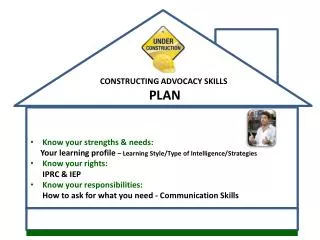
CONSTRUCTING ADVOCACY SKILLS PLAN • Know your strengths & needs: • Your learning profile – Learning Style/Type of Intelligence/Strategies • Know your rights: • IPRC & IEP • Know your responsibilities: • How to ask for what you need - Communication Skills
Learning Disability Facts INVISIBLE DISABILITY Brain processes information differently Ability to think is not affected Average to Above Average Intelligence Great abilities Difficulties with: -writing -spelling -reading -math -organization We use different methods and/or equipment to complete school work.. Lifelong We learn to negotiate our learning disability. Tested on our weaknesses Common 1 in 10 Hereditary Ranges from mild to severe
EXPLORE FURTHER Learning Style Quiz Sites: www.edutopia.org/Quiz www.studysuccess.co.uk/learning_questionnaire.htm www.educationinsite.com Developed by Dr. Linda Karges-Bone Also lists a 6 Question Kids Style Quiz (Gr. 5-8) www.engr.ncsu.edu/learningstyles/ilsweb.html http://homeworktips.about.com/od/homeworkhelp/a/learningstyle.htm Parent Quiz to explore the learning styles for young students http://parenting.quiz.kaboose.com/25-what-s-your-child-s-learning-style www.ldao.ca
Learning Style (Sensory Approach) Your learning style affects how you prefer to take in new information. Visual Learner -benefit from seeing information in a written format or in an illustration -may grow impatient listening for long periods of time. Auditory Learner -best at absorbing information when it is delivered orally -visual cues reinforce learning but hearing information is preferred Kinesthetic/Tactile Learner -prefers to be active while processing new information -frequent short breaks and/or interacting with the material increases your ability to learn
VISUAL LEARNER (Information comes in through the eyes) AUDITORY LEARNER (Information comes in through the ears) TACTILE/KINESTHETIC LEARNER (Learning incorporates movement)
Learning strategies to improve academic learning http://www.dartmouth.edu/~acskills/videos/index.html Note taking, Listening, Participation 8 ½ minutes Techniques for effectively recording and learning information from classes Managing Your Time 18 minutes Time Management - methods for getting organized and making better use of your time Reading Improvement: Comprehension and Rate 11 minutes Strategies for improving reading rate and comprehension Improving Concentration, Memory, and Motivation 9 minutes Strategic Learning - a three-step process for meaningfully understanding and retaining information Preparing and Taking Tests and Exams Stress Management - learn more about stress and stress management techniques Mind Mapping: Smart Ideas / Inspiration Organization: Rainlender
The questions aren’t: Are you smart ? Do you have abilities? The questions are: What kind of smart are you? What kind of abilities do you have? The ability to read and write are not a measure of intelligence. Howard Gardner Ph.D. Social Psychology Professor Harvard University Education tends to be focused on a limited window of learning Book Smart Logical Mathematical Interpersonal Visual/Spatial Smart (Language) (Numbers / Science) (Interested in others) (See It / Conceive It) Intrapersonal Naturalists Bodily-Kinesthetic Musical (Reflectors) (Investigators) (Active / Movers) (Hummers / Tappers)
4 or more in any of the Categories A - E indicates your strongest abilities. 1 or more in Categories F & G means you have abilities in those aspects as well.
Differentiated Instruction Based on a student centered approach ask for an assignment - CHOICE - Build a model / Create a collage / Create an advertisement Create a brochure / Create a bumper sticker / Create cartoons / Create a dance Create a “how-to” / Create a mind-map with or without software / Create a political cartoon Create a Power Point / Create a recipe / Defend a theory Design a brochure / Design and construct a new product Design a game / Develop a Rubric / Draw a diagram / Draw a graph Design and make costumes / Design a Web Quest / Give a demonstration Give a speech / Illustrate a story / Illustrate a math concept / Interview an expert Invite a speaker / Keep a diary / Make a calendar / Make a learning center Make a map / Make a mural / Make a puzzle / Make a simulation game Make a tape recording / Paint a picture / Present a news report Produce a multimedia presentation / Re-enactment of an event Set up a system of checks & balances / Teach a lesson / Take a survey Write a book / Write an essay / Write a letter to the Editor Write a diary from someone else’s perspective / Write a monologue / Write a news report Write an opinion article / Write a poem / Write a song / Write and perform a rap Write a story / Write and/or tape a conversation Choice needs to be focused on absolutely essentiallearning goals.
Shared Solutions / Culture of Collaboration Steps in Problem Solving ☼ Define the issue ☼ Share issues and ideas ☼ Generate and explore possible solutions ☼ Predict consequences ☼ Choose a solution & develop a plan of action ☼ Develop a follow-up evaluation
Shared Solutions / Culture of Collaboration Conflict Resolution Do’s & Don’ts Strong Advocates “Do the Do List”
The Individual Education Plan Document Addresses: • The student's areas of strengths and needs. • Strategies and Resources: • Specific accommodations, human and material resources Teaching strategies required by the student • Intensity of the support required & who is responsible. • Method of evaluation and monitoring cycle. http://www.nldontario.org/articles/IPRCandIEPguide.html
ACCOMMODATIONS Assistive Technology - Video Instructions Editing Checklist for textHELP Read and Write: http://www.youtube.com/watch?v=h3cIVuZp1wA Exporting / Importing Dragon Voice files: http://www.youtube.com/watch?v=0uTF00j_hr8 Virtual Printingwith Kurzweil 3000: http://www.youtube.com/watch?v=McgGlLL3I2A How To-s of Zone Editingin Kurzweil 3000: http://www.youtube.com/watch?v=aLlIPWRKVTc Creating Flash Cards using Kurzweil 3000: http://www.youtube.com/watch?v=Z2DgLTs8G6A Zone Editing using Kurzweil 3000: http://www.youtube.com/watch?v=yUBQn2eV65s Creating Flash Cards in PowerPoint: http://www.youtube.com/watch?v=rU-L1qrbVH0 Planning for Success – PDF demonstration: http://www.youtube.com/watch?v=gNFNp_iFPEE Planning for Success – Excel demonstration: http://www.youtube.com/watch?v=uHetqB0oLF0
My Learning Profile Hi, my name is __________________. I am looking forward to studying ______________ in your class. I am a smart student who wants to be successful. My Type of Intelligence is: _______________________. My Learning Style is: _______________________. I am currently using the following learning strategies with success: _________________________________________________________ _________________________________________________________ _________________________________________________________ I use the following assistive technology software with success: _________________________________________________________ _________________________________________________________ I use the following pre-approved accommodations, (listed in my IEP): _________________________________________________________ _________________________________________________________ _________________________________________________________ I would be happy to meet with you to discuss my needs. Respectfully, _______________________.
Director James Redford Featuring accounts by students, experts and iconic leaders. Monday, October 29th 7:00 p.m.
What kind of smart are you? QUIZ www.spannj.org/BasicRights/appendix_b.htm
Add up each row: 4 or more “Trues” in any of the Categories A - E indicates your strongest abilities. 2 or more “Trues” in Categories F & G means you have abilities in those aspects as well. www.spannj.org/BasicRights/appendix_b.htm
Add up each row: 4 or more “Trues” in any of the Categories A - E indicates your strongest abilities. 2 or more “Trues” in Categories F & G means you have abilities in those aspects as well. www.spannj.org/BasicRights/appendix_b.htm
Add up each row: 4 or more “Trues” in any of the Categories A - E indicates your strongest abilities. 2 or more “Trues” in Categories F & G means you have abilities in those aspects as well. www.spannj.org/BasicRights/appendix_b.htm
Add up each row: 4 or more “Trues” in any of the Categories A - E indicates your strongest abilities. 2 or more “Trues” in Categories F & G means you have abilities in those aspects as well. www.spannj.org/BasicRights/appendix_b.htm