Analyzing Forces and Torques on a Beam: Shear, Bending, and Differential Equations
This document explores the complex interactions of forces and torques on a beam, emphasizing key concepts such as shear forces, bending moments, and the effects of applied loads. It discusses critical parameters like angles of shear and bending, and the influence of beam geometry on performance. A detailed examination of boundary conditions, particularly at free ends and points of applied force, is included to provide clarity. The theoretical background is complemented with problem-solving strategies to enhance understanding of beam behavior in various scenarios.

Analyzing Forces and Torques on a Beam: Shear, Bending, and Differential Equations
E N D
Presentation Transcript
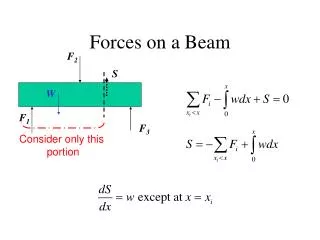
Forces on a Beam F2 S W F1 F3 Consider only this portion
Torques on a Beam F2 W N N0 F1 F3 Consider only this portion
Shear at AA Plane A No Bending – Planes stay parallel S q A
Beam BendingTension and Compression Compression Tension k=radius of gyration
Formulae Total angle: Shear angle: Bending angle: Shear force: Bending moment:
0 :assume constant beam geometry 0:Symmetry 0:Definition Solution
Book Problem q Only shear at x=0 Beam held fixed at one end 0
Book Problem – Solution Also solution to following problem: L W W Except with |x| instead of x. There is a discontinuity in q at x=0.
Boundary Conditions At free ends: At points of applied force: Bend angle is continuous: Shear angle is discontinuous: