Understanding ROM and Solid State Memory: Key Differences and Functions
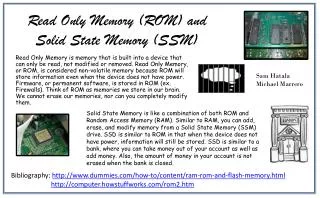
Solid State Memory (SSM) merges features of Read Only Memory (ROM) and Random Access Memory (RAM). Like RAM, SSM allows for adding, erasing, and modifying data, while it shares ROM's ability to retain information without power, similar to a bank account where you can withdraw and deposit funds without losing your balance when closed. ROM is immutable memory, designed for permanent storage like firmware, making it non-volatile. This comparison provides a clearer understanding of how different memory types function and interact in digital devices.

Understanding ROM and Solid State Memory: Key Differences and Functions
E N D
Presentation Transcript
Read Only Memory (ROM) and Solid State Memory (SSM) Sam Hatala Michael Marrero Solid State Memory is like a combination of both ROM and Random Access Memory (RAM). Similar to RAM, you can add, erase, and modify memory from a Solid State Memory (SSM) drive. SSD is similar to ROM in that when the device does not have power, information will still be stored. SSD is similar to a bank, where you can take money out of your account as well as add money. Also, the amount of money in your account is not erased when the bank is closed. Read Only Memory is memory that is built into a device that can only be read, not modified or removed. Read Only Memory, or ROM, is considered non-volatile memory because ROM will store information even when the device does not have power. Firmware, or permanent software, is stored in ROM (ex. Firewalls). Think of ROM as memories we store in our brain. We cannot erase our memories, nor can you completely modify them. Bibliography: http://www.dummies.com/how-to/content/ram-rom-and-flash-memory.html http://computer.howstuffworks.com/rom2.htm