Understanding Diplomas 14-19: Their Purpose and Impact on Education Sector
This overview explores the 14-19 Diplomas in the UK, designed as ambitious, multi-component programs that replace the GNVQ. Aimed at enhancing educational outcomes, these diplomas feature a combination of principal, generic, and additional specialist learning, with a clear progression from Level 1 to Level 3. While they promise a robust alternative to traditional qualifications, implementing these diplomas presents challenges in terms of management, logistics, and delivery. It highlights their significance, growth prospects, and their role in shaping the future of education.

Understanding Diplomas 14-19: Their Purpose and Impact on Education Sector
E N D
Presentation Transcript
14-19 Diplomas What are they and what impact have they had upon the sector?
They are… (1) Not: • a simple, undemanding or occupational programme of study • easy to understand • an alternative to apprenticeship (Diploma learning is not ‘work-based’, but ‘applied’) • a dead-end: progression through Levels 1-3 is integral to their design • wholly convincing to leading universities • starting all at once • starting on a large scale • necessarily here to stay…
They are… (2) • a successor to GNVQ • ambitious, multi-component programmes • heavily sponsored by the state • endorsed / co-designed by some employer groups and universities • complex to manage • difficult to ‘deliver’ (i.e. teach) • in their first term of operation • in competition at L3 with diploma-style awards such as the IB
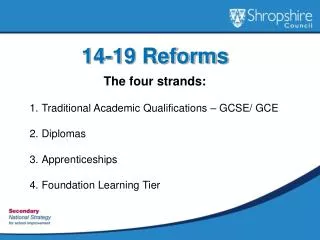
Diploma design • 17 ‘Lines of Learning’ (i.e. subject areas) • 2008: IT; Society Health & Development; Engineering; Construction & Built Environment; Creative & Media. • 2009: Environmental & Land Based; Manufacturing & Product Design; Hair & Beauty; Business Administration & Finance; Hospitality. • 2010: Public Services; Sport & Active Leisure; Retail Business; Travel & Tourism. • 2011: Humanities*, Languages*, Science*. starting in Exeter in 2009 * Conservative Party pledged to abolish • 3 levels: • L1: Foundation Diploma (600 guided learning hours, ‘equivalent, in terms of average length of study, to five GCSEs’). • L2: Higher Diploma (800 guided learning hours, ‘equivalent, in terms of average length of study, to seven GCSEs’). • L3: ‘Progression’ Diploma and ‘Advanced’ Diploma • Three main components: • Principal learning • Generic learning • Additional and specialist learning • Extended Diploma – available from 2011 for the ‘most able learners’ at each level
Detailed example The Level 3 Diploma
Impact on the FE sector (1) • Complex to manage (i) • facilities • curricula • staffing • timetabling • assessment • Complex to manage (ii) • logistics • group sizes • teaching locations* * City of Exeter programme of provision: 2008 IT → West Exe Society Health & Development → St James’ Engineering → St Luke’s Construction & Built Environment → College Creative & Media → ISCA 2009: Hair & Beauty→ College Hospitality→ West Exe / College Environmental & Land Based → St Luke’s / Bicton
Key issues / prospects • IAG – especially in Year 9 • Patterns of provision: In 2008, of 97 local authorities, the incidence of the first five ‘lines’ is: • Creative & Media (62); Engineering (60); IT (45); Construction & Built Environment (44); Society Health & Development (39) • Take-up • Original Govt. goal in 2008: 40,000 • Summer 2008 estimate: 20,300 • October 2008: confirmed starts: 11,490, of which: • 8,128 pre-16 • 3,362 post-16 • 1,416 at L3 (11 per-HEI if all were to progress) • Cost: start-up = £55m. • Rise and rise of the IB?