Understanding Earth's Crust Deformation: Stress, Folding, and Faulting
60 likes | 179 Vues
This chapter explores the processes that lead to deformation in the Earth's crust, focusing on stress types, including compression and tension, and how they contribute to folding and faulting. Key concepts like anticlines, synclines, and fault blocks are discussed, alongside the mechanics of uplift and subsidence. The impact of tectonic forces on rock layers is illustrated with diagrams of plate tectonics and mountain building, highlighting the formation of folded, fault-block, and volcanic mountains.


Understanding Earth's Crust Deformation: Stress, Folding, and Faulting
E N D
Presentation Transcript
Deforming the Earths Crust Chapter 4 Section4
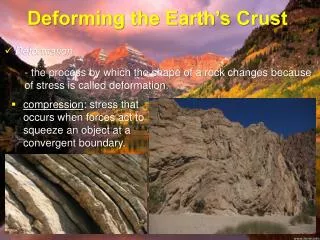
Stress • Deformation • Compression • Tension • Folding • The amount of force per unit are on a given material • Process by which the shape of a rock changes because of stress • Stress that occurs when an object is squeezed (convergent( • Stretch an object( divergent) • Bending layers
Types of Folds • Anticline • Syncline • Monocline • Upward arching folds • Downward trough like folds • Both ends of the folds are horizontal
Faulting • Fault • Fault Block • Foot wall • Hanging wall • Normal Fault • Reverse fault • A break in a body of rock along which one block slides relative to another. • Block of crust on each side of the fault. • Draw images
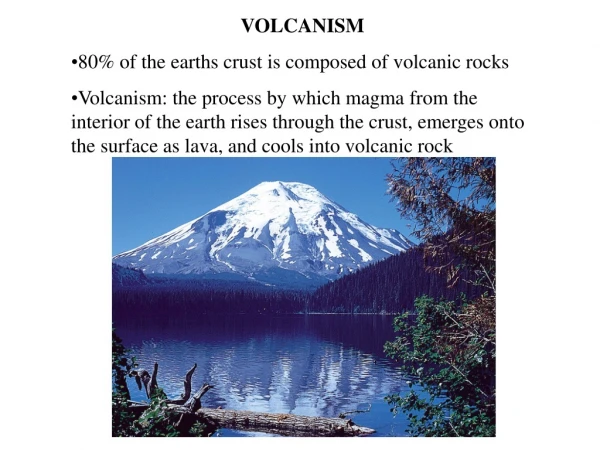
Plate tectonics and Mountain Building • Folded Mountain • Fault Block Mountain • Volcanic Mountain • Rock layers are squeezed together and pushed upwards • Tension causes large blocks of earths crust to drop down • Rock that melts in subduction zones forms magma and which rises to earths surface and erupts
Uplift and Subsidence • Uplift • Subsidence • Rebound • Rift zone • Rising of earths crust to higher elevations • The sinking of regions of earths crust to lower elevations • Slowly springs back to a previous elevation • Deep cracks that forms between 2 tectonic plates that are pulling away from each other