Download
1 / 18
180 likes | 325 Vues
This document provides a comprehensive overview of DNA replication and protein synthesis. It covers the structure of DNA, the roles of nucleotides, purines, and pyrimidines, and details the processes of DNA replication, including both prokaryotic and eukaryotic mechanisms. Additionally, it explains transcription and translation, highlighting the functions of various enzymes like RNA polymerase and ribosomes. The document also discusses critical concepts such as the semi-conservative nature of DNA replication, the significance of introns and exons in mRNA processing, and the impact of mutations on protein synthesis.

E N D
DNA Replication and Protein Synthesis Taylor Reich January 8, 2010
Structure of DNA • Sugar+Phosphate+BasePair(A, G, C, or T)=Nucleotide(basic unit) • Purrines- A, G; Pyrimedines- C, T • A bonds with T- Double Hydrogen Bonded • G bonds with C- Triple Hydrogen Bonded • Covalent Bonds- sugar- phosphate, sugar-basepair • 3’ and 5’ ends • DNA -> hystome -> nucleosome -> supercoil • Major/Minor Grooves- hollow center (Think Staircase) • Two Thins for DNA • DNA Replication (self-replicates) • Protein Synthesis purines pyrimidines Sugar Phosphate
DNA Replication in Prokaryotes • Enzymes read opposite directions • 500 Nucleotides/second • Origin of Replication • Ring DNA
DNA Replication • Semi-conservative • Half old DNA, half new DNA • DNA polymerase (replicates DNA) • Reads 3’->5’; Makes 5’->3’
Eukaryotic Replication: Enzymes and their Functions • DNA B- mark replication site • DNA gyrase- uncoil DNA • Topoisomerase- knick DNA (release tension) • rep(helicase)- split DNA (break hydrogen bonds) • SSB (single strand binding)- hold complimentary DNA apart
Eukaryotic Replication: Enzymes and their Functions • RNA Primase- attach 10 RNA nucleotides • Okazaki fragments (lagging strand) • DNAPolymerase III- replicate okazaki fragments (lagging) DNA strand (leading) • DNA Polymerase I- replace RNA nucleotides with DNA ones (from primer) • Ligase- bond nicks from topoisomerase
Eukaryotic DNA Replication • 50 nucleotides/second • Leading and Lagging Strand
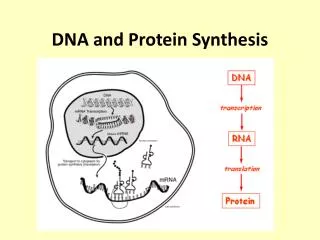
Protein Synthesis • Transcription • Make RNA from DNA • Nucleus • Translation • Make protein from RNA • Ribosome (cytoplasm)
Transcription [1] Splits DNA [2] Synthesizes RNA nucleotides [3] Re-bonds DNA • Parts of a gene: • RNA Polymerase makes RNA • Binds to promoter if it’s on, it moves to the start signal, synthesizes on RNA Start signal Stop Signal TATA TAC ORF (random sequence) Termination Sequence Promoter on/off switch • Open Reading Frame • codes for protein
Transcription • Have a mRNA strand from DNA • Add: • Cap: composed of 7 guanines; put on 5’ end • Tail: composed of 100-200 adenines; put on 3’ end • The more adenines attached, the longer the mRNA lasts • Remove: • SNRNP [Small Nuclear Ribo-Nuclear Protein] • Cuts out introns • Hooks together exons • [Spliceosome (SNRNPS&other proteins)] • Introns stay IN the nucleus; Exons EXIT the nucleus and continue on to the ribosome for translation…
Amino Acid (each tRNA has specific amino acid) Anticodon (three nucleotides) Translation • Ribosomes • Split/Come together all the time • Made up of two parts: small unit & large unit • tRNA (transfer RNA) • aminoacyl-tRNA synthetase • Whole group of slightly different enzymes. Each has 2 binding sites: 1) particular tRNA 2) particular amino acid
Translation • Step 1: small unit of ribosome binds with 5’ end of mRNA • Step 2: initiation factors(proteins) bind to mRNA and ribosome • Step 3: tRNA binds using initiating factors (on start signal of mRNA) (anitcodon binds) • Every start signal on mRNA is AUG (so tRNA nucleotide is UAC) • Step 4: Large unit of ribosome binds, leaving a space b/t the 2 parts of theribosome- the A-site, and the P-site • Step 5: knock off initiating factors, attach elongation factors- activate ribosome to do this: • Look for tRNA w/ completmentary anticodons to mRNA codon at the A-site • Step 6: peptidyl transferase forms a peptide bond b/t amino acids, and breaks bond between amino acid and tRNA at the P-site • Step 7: mRNA moves down 1 codon, tRNA at P-site, leaves, tRNA shifts, ribosome does it’s job, new tRNA arrives, whole process repeats • Result: A chain of Amino Acid, A.K.A. a PROTEIN
Transformation Tidbits • The sequence of nucleotides on mRNA determines the correct order of the amino acid chain, determining the correct protein…or not • Frame Shifting- loosing/gaining a nucleotide- changes every codon= wrong protein produced • Substitution- affects only one codon- not always a different amino acid • “Wobble Affect”- if the first or second letter (base pair) are wrong, it will be a different amino acid, if the third letter is wrong, it may not be • Release/Termination factor- binds to P-site at the end of the mRNA chain, ribosomes split • Can be more than one ribosome on a mRNA chain at a time • Polycistronic: a messenger RNA that codes for more than one protein
Stops the production Negative Feedback • When DNA is read, producing enzymes, creating a product, the product concentration gets high. Two things can happen: • Product binds to the DNA • Product binds to the enzymes • When the concentration gets low enough, the product falls off of the DNA/enzymes, commencing production once again • Operator- b/t promoter and start signal • Regulator- before promoter, usually turned on being read, giving out mRNA. It makes the… • Repressor- a protein that binds to the operator, turning off the gene Regulator Promoter Operator Start Signal ORF Termination Signal
Negative Feedback:Induction, Corepression, & CAP • Inducer- a substrate that binds to repressor, deactivating it/knocking it off the DNA. The DNA is turned on. When it falls off the repressor, the repressor sits on the operator, turning off gene. It is called Induction • Sometimes, the product is the substrate for the inducer, so when there is a high concentration of product, it turnes off the gene. That is called Corepression • The product concentration is the important thing in these processes • Overriding the system is possible with CAP. Turns on the gene when cAMP sits on DNA, the DNA bends, knocking off the repressor, activating CAP, and the gene turns on • cAMP goes to mitochondria, gets phosphates, turns to ATP, CAP comes off DNA, DNA goes back to original shape, repressor binds w/ corepresser, sites on DNA, and the gene turns off • Can’t be done consciously
More on Gene Structure About 10,000 base pairs gene • DNA bends so that the Initiation Gene touches the Promoter, which is bond to the Transcriptional Factor Gene, the Enhancer Gene, and the DNA