Communications
This comprehensive guide explores key barriers to effective communication, including issues related to the communicator's credibility, attractiveness, and message encoding. It discusses cognitive and emotional appeals, noise interference, information overload, and the role of audience effects such as ego threats and resistance to persuasion. Additionally, it delves into impression management techniques, non-verbal communication cues, and the importance of understanding social and cultural differences in communication styles. A valuable resource for enhancing personal and professional communication skills.

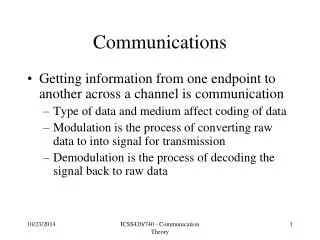
Communications
E N D
Presentation Transcript
Communications Dr Joan Harvey Dr George Erdos
Barriers to effective communication • Communicator issues • Problems encoding the message • Credibility of communicator • Attractiveness of the communicator
Communications barriers: message issues • Cognitive or affective appeals? • Message interrupted by noise -neural or psychological • Information overload • One sided or two sided • Primacy or recency
Communications barriers: message issues cont • Size of attitude discrepancy • N of points and repetition • Summarise the message
Communications barriers: audience effects • Threatening the ego • Resistance to persuasion: • Self esteem • Inner directed • Need for social approval • Depressed • Strong ideological beliefs • Internal locus of control • Public commitment • Mood and emotion effects • Feedback
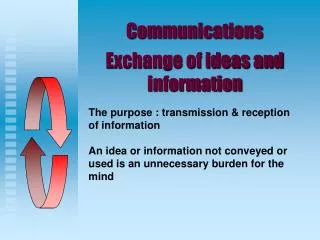
Communications cycle • Information • Encode • Transmit • Audience • Decode • Feedback
Impression management • Ingratiation • Opinion conformity • Mixing agreement with disagreement • Initial disagreement followed by agreement • Favour doing • Flattery • Other enhancement • Must be credible • Timing, frequency and discernment important • Self enhancement • Find out what target thinks is attractive and adopt it
IM continued • Self promotion • to be perceived as competent rather than to be liked • Intimidation • to be feared • Exemplification • managing impression of integrity, self sacrifice & moral worthiness • Supplication • exploiting own weaknesses
IM continued • Indirect IM techniques • Use associations with positive others • E.g. celebrity endorsements • Acclaiming • Explain a desirable event to give maximum desirable implications for yourself • Non-verbal IM tactics • Facial expressions, posture, • TA techniques
Protective IM • Accounts are: • “statements made to explain untoward behaviour and bridge the gap between actions and expectation” • Motive talk • Neutralisation • Excuses and justifications • Quasi-theories • Aligning actions
IM: the headline- this situation needs to be impression managed!
Communications and IM cont • Excuses • Appeal to accidents • Appeal to defeasibility • Appeal to biological drives • Scapegoating • Justifications • Denial of injury • Denial of the victim • Condemn the condemners • Appeal to loyalties
IM: excuses: an example of scapegoating when accidents and defeasibility didn’t work Several examples of this in UK
Other protective IM behaviours • Disclaimers and hedging • Credentialing • Sin licences • Cognitive disclaimers • Appeal to suspension of judgement • Self handicapping • Apologies
Examples of different types of IM behaviour Social desirability- to make ones self appear in best light Social approval- to give answers that you think the other person is wanting Self-deceptive enhancement- to deliberately over-report good behaviour and under-report poor behaviour
Other examples of IM behaviours • Politicians caught in problem situations • Mismanagement by UK Govt of health scares such as BSE • Responses of industry to crises e.g. • Monsanto and GM foods, • Toyota and accelerator recall, • BP and Deep Water Horizon • Mox fuel crisis at BNF
Different types of IM behaviour • Attributive or repudiative tactics- ascribe positive traits to self and deny existence of negative ones • Ingratiatory behaviours • Concern with maintenance of face • Machiavellian behaviour • Willingness vs unwillingness to communicate positive and negative information
Language • Redundancy and generative power • Structure of language e.g. processing times for form filling • Meaning of language differences • Social class [Bernstein] • Cultural differences [Argyle etc]
Non-verbal communication • Personal space and social distance • Reflective listening skills • Very popular for management training now • Non verbal cues [“tells”] • Posture • Gesture • Gait • Facial expressions
And finally • Visual, audio or written? • It depends • Simple messages, V-A-W • Complex messages- Written best • Also gender differences
Thank you for listening • Joan Harvey and George Erdos • Newcastle University • PEF, CZU