Analyzing Linearity and Time Invariance in RC Circuits
This resource explores the properties of linearity and time invariance in systems, specifically through the example of an RC circuit. It explains that a system is linear if it conforms to specific input-output relationships, and it demonstrates time invariance using formulas and assumptions. By contrasting linear and time-varying systems using signals and examples like amplitude modulation, the text elucidates key concepts in system theory, including causality, memory, and the distinctions between causal and non-causal systems.

Analyzing Linearity and Time Invariance in RC Circuits
E N D
Presentation Transcript
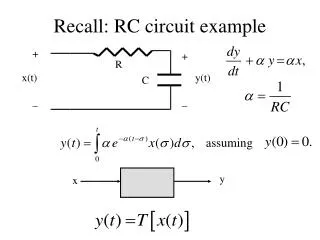
y x Recall: RC circuit example + + R x(t) y(t) C _ _ assuming
y x Properties of Input-Output Systems Linearity. The system is linear if Example: RC circuit is linear. Follows from equation
Time Invariance Property: If , then x In words, a system is T.I. when: given an input-output pair, if we apply a delayed version of the input, the new output is the delayed version of the original output. t y t t t
+ + R x(t) y(t) C _ _ Time invariance of RC circuit Seems intuitive based on physical grounds Let’s prove it using the formula Assume all signals are zero for t < 0. Introduce the notation
Now, apply the delayed input x(u) = 0 for u < 0 Remark: proof works for any h(t)!
Another example: y(t) = t x(t) x(t) 1 Linear? Yes, easy to show. Time invariant? No: 1 y(t) 1 x(t-1) 2 T[x(t-1)] They are different! Compare for a particular x(t) 1 Time-varying system 1 y(t-1) t 1 2
y x Example: amplitude modulation + y(t) x(t) Used in AM radio!
Modulator Again, this is a linear system. Is it time invariant? Only equal if Therefore, it is a time varying system Notation: LTI = linear, time invariant LTV= linear, time varying
Causality and memory • A system is causal if y(t_0) depends only on x(t), t <=t_0 • (present output only depends on past and present inputs) • A system is memoryless if y(t_0) depends only on x(t_0) • (present output only depends on present input). • Causal, not memoryless: we say it “has memory”. Examples: Delay system is causal, and has memory. Backward shift system is non-causal: output anticipates the input. Non-causal systems are not physically realizable
![What is an IC ? [integrated circuit]](https://cdn0.slideserve.com/59701/slide1-dt.jpg)

![G6 - CIRCUIT COMPONENTS [3 exam question - 3 groups]](https://cdn0.slideserve.com/528131/g6-circuit-components-3-exam-question-3-groups-dt.jpg)