Key Developments in Early 1800s America: Expansion, Legislation, and Judicial Cases
Explore pivotal chapters in early 19th century American history, covering significant treaties, legislation, and legal cases that shaped the nation. From the Treaty of Paris ending the Revolutionary War to the establishment of foundational land policies like the Land Ordinance and Northwest Ordinance, these events contributed to westward expansion. Key figures such as Alexander Hamilton and Chief Justice John Marshall influenced economic and judicial principles. The War of 1812 and its aftermath further solidified national identity and expansionism during this transformative era.

Key Developments in Early 1800s America: Expansion, Legislation, and Judicial Cases
E N D
Presentation Transcript
Early 1800s Chapters 6-8 Pages 174-245 Standard III: Objectives 2 & 3 Era of Expansion
A. Treaty of Paris • Treaty that ended the Revolutionary War • September 3, 1783 • Set the boundaries of the new nation • U.S. stretched from the Atlantic Ocean to the Mississippi River and from Canada to the Florida border • All nations recognized the United States of America
B. Land Ordinance of 1785 • Divided Old Northwest into townships • Congress did not have the power to raise revenue by the direct taxation of U.S. Citizens • Therefore, decided to raise money by selling unmapped territory west of the 13 original colonies • Laid foundation of land policy in the U.S. until passage of the Homestead Act in 1862 • Combined with Northwest Ordinance to resolve issues of statehood
C. Northwest Ordinance of 1787 • Created the Northwest Territory – 1st organized territory of the U.S. • Single most important legislation passed by the earlier Continental Congresses (besides the Declaration of Independence • Established the precedent by which the U.S. would expand westward and form new states
D. Alexander Hamilton • First Secretary of the Treasury under George Washington • One of the Founding Fathers • Sought to manage debt • Believed the government should play an active role in the development of the economy • Created tariffs, taxes, and paid interests to creditors – led to theestablishment of theBank of the United States • Transformed debts of state governments into long-term investment in the U.S government
E. XYZ Affair • After John Adams was elected President, the U.S. began to have conflict with France • French were angry about Jay’s Treaty • Seized American ships in French ports • Adams sent officials to Paris to resolve conflict • Officials met by agents X, Y, & Z • Demanded bribe of $250,000 & Loan of 10 million before they could see the French foreign minister (Talleyrand) • “Millions for defense, but not one cent for tribute”
F. Presidential Election of 1800 • Referred to as the “Revolution of 1800” • Thomas Jefferson defeated John Adams • Realigning election that started a generation of Democratic-Republican rule • Eventually ended the Federalist Party (formed by Hamilton) • Election was a tie in the electoral vote • Hamilton intervened on Jefferson’s behalf • Burr shot Hamilton and he died the next day (1804)
G. Chief Justice John Marshall • Served from 1801-1835 • Establish many important principles of constitutional law • The longest serving Chief Justice in Supreme Court History • Helped to build the prestige of the Supreme Court through various landmark cases
H. Marbury v. Madison • 1803 • Basis of the exercise of judicial review – making sure laws passed by Congress are constitutional • William Marbury sued James Madison because Madison would not allow him to take office as justice of the peace • Marshall ruled against Marbury declaring it was unconstitutional for the Supreme Court to give this order to the executive branch
I. McCulloch v. Maryland • 1819 • Case involved Maryland’s attempt to wipe out the National Bank levying heavy taxes on it • Marshallruled that Congress had the authority to charter the National Bank • Because the national government had created the bank, no state had the power to tax it
J. Gibbons v. Ogden • 1824 • Aaron Ogden purchased a state license giving him exclusive rights to operate a steamboat line • Thomas Gibbons started a business on the same route, saying he operated under a federal license • Ogden sued Gibbons • Marshall declared that the power to regulate interstate navigation was granted to Congress • Court sided with Gibbons
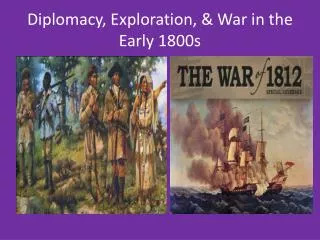
K. War of 1812 • British had encouraged Indians to attack American settlers • British had also interfered with American shipping • U.S. had tried to stop the British practice of impressment – the act of forcing people into military service • President James Madison called for war, Congress approved
L. War of 1812 Battles • Defense of Fort McHenry – 1814 – Baltimore harbor; British bombarded the fort. • Francis Scott Key witnessed and wrote the Star Spangled Banner (“And the rocket’s red glare, the bombs bursting in air….”) • Battle of Horseshoe Bend – 1814 – fought in central Alabama near Dadeville (Tallapoosa County) • Troops under Andrew Jackson defeated the Red Sticks, led by Tecumseh, ended the Creek War • Jackson wanted to “clear” Alabama for settlement
M. Battle of New Orleans • Treaty of Ghent – Treaty that officially ended the war • Yet, two weeks after treaty was signed the U.S. experienced their greatest victory • January 8, 1815-Fought at Chalmette Plantation • News had not reached New Orleans • Jackson’s troops soundly defeated the British to win the war
N. Post-war Boom and Panic • 1815 – entered period of growth and prosperity • James Monroe won the election of 1816 • Republicans dominated, Federalists faded away • 1819 – first great depression (Panic of 1819) • Growth of nationalism-a nation has the right to constitute a independent political community based on shared beliefs