Innovative Internal Fixed Packing Processes for Attached Growth in Wastewater Treatment
Ringlace packing utilizes a looped PVC material (5 mm diameter) for enhanced reactor performance, covering 25-35% of reactor volume with spaced individual strands that maximize specific surface area (120-500 m²/m²). With over 100 installations across Europe and North America, alternatives like Biolite clay (2-4 mm) and polystyrene beads (2-4 mm) effectively remove BOD and nitrification. This technology supports various applications, including post-denitrification and landscaping, although care must be taken to avoid disease transmission through wastewater irrigation.

Innovative Internal Fixed Packing Processes for Attached Growth in Wastewater Treatment
E N D
Presentation Transcript
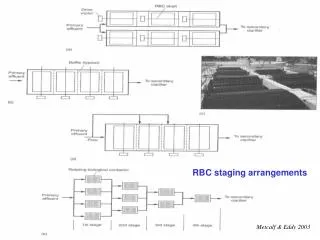
9. AS processes with internal fixed packing for attached growth (http://www.ringlace.com/Presentation/) Ringlace® packing is a looped polyvinyl chloride (PVC) material (~5 mm in diameter); 25-35 % of reactor’s volume; individual strands at 40-100 mm apart; specific surface area 120-500 m2/m2.
12. Biofor® >100 installations in Europe and North America
Bed depth 2-4 m; packing termed Biolite®, an clay material 2-4 mm.
Used for BOD removal and nitrification/ tertiary nitrification and denitrification
13. Bed depth 1.5-3 m; packing with polystyrene beads 2-4 mm; specific surface area 1000 m2/m2.
Used for BOD removal only/ combined BOD removal and nitrification/ tertiary nitrification and post-denitrification.
Average effluent BOD, TSS and NH4-N concentrations of 7, 11 and 1.8 mg/L, respectively for long-term operation. Biostyr®
14. Fluidized-Bed Bioreactor (FBBR) For aerobic applications, influent is aerated to predissolve oxygen, because adding air to the bed will discharge packing to the effluent;
Mainly for post-denitrification
15. Attached Growth Denitrification Processes
16. Attached Growth Preanoxic Denitrification
22. Land Application and Landscaper Irrigation Risk of the transmission of disease through the use of untreated wastewater for vegetable irrigation.
Studies has shown that bacterial levels are highest on leafy vegetables such as lettuce and cabbage, as high as 37,000 TC per 100g or 3,600 FC per 100g
Rinsing in tap-water does not reduce the indicators to safe levels and outbreak of diseases such as cholera have been associated with wastewater irrigation of vegetables.
Outbreaks of parasites have also been linked to this practice.
23. Land Application and Landscaper Irrigation In Israel, stool samples containing Ascaris worms climbed to 35% when wastewater irrigation was used but fell to <1% after it was banned.
In the US, a coliform level of 2.2 per 100 ml wastewater is allowed for food crops whereas for non-edible crops and/or for general landscape irrigation, it is 5,000 per 100 ml, and for recreational use 23 per 100 ml.