Where we left off
This overview delves into the principles of diffusion, highlighting its sufficiency for small biological molecules, such as bacteria, while contrasting it with the transport needs of larger organisms. It examines the time required for molecular displacement, the relevance of Fick's Laws, and the reasons why diffusion cannot adequately serve complex systems like human bodies. Through exploring random walks and concentration gradients, this analysis underscores the cellular nature of life and the importance of circulation in higher organisms.

Where we left off
E N D
Presentation Transcript
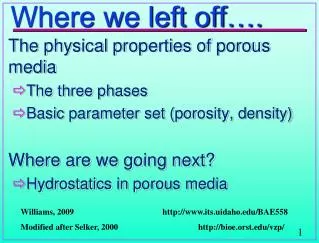
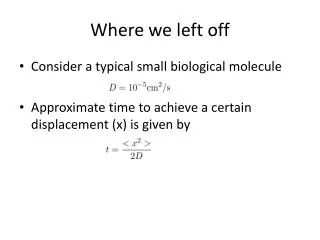
Where we left off • Consider a typical small biological molecule • Approximate time to achieve a certain displacement (x) is given by
To cross 1 micron, ~0.5 milliseconds • To cross 1 cm, ~14 hours • What about us? • What about for oxygen to get from our lungs to a finger (~1 m)? • D for O2 in water at 40 C is ~3x10⁻⁵ • This is neglecting any additional hindrance due to having to cross cell membranes, etc.
Conclusion? • Bacteria don’t need circulatory systems! • Diffusion is sufficiently rapid to transport molecules throughout the cell • But we do! • Diffusion is far too slow to transport molecules throughout the body • Diffusion limitation is one reason for the cellular nature of life
Diffusion Step Size and Step Rate • Knowing and , we can solve for delta and tau • For comparison, the diameter of a hydrogen atom is 1 angstrom • or 2 picoseconds per step
Random Walks • An individual particle • does not explore space uniformly • has no memory of where it has been • is more likely to explore near where it is than to go far away into a new area, however • if in a new area, it is more likely to stay near there than to wander far away again
Fick’s First Law • Fick’s first law regards the flux of a substance due to diffusion • Consider our simple discrete model (on the board) • Moving across to the right • Moving across to the left • Net Rightward:
Fick’s First Law • What do we need to turn a net number of particles moving into a flux? • Normalize by area (A) and time (tau) • Want to relate to diffusion coefficient • Mult by , rearrange
Fick’s First Law • Flux due to diffusion is proportional to the concentration gradient
Fick’s Second Law • Follows from the first, assuming particles are conserved • Consider a box between x and x+delta, each face of the box has area A • Flux in from the left is Jx(x) and flux out at the right is Jx(x+delta), volume of the box is A*delta
Fick’s Second Law • Concentration change is • proportional to change in flux • proportional to the second derivative of the spatial concentration profile • Diffusion coefficient is the constant of proportionality