
Systematization of Line Strength Factors for Alkaline-Earthlike Ions and Transitions
E N D
Presentation Transcript
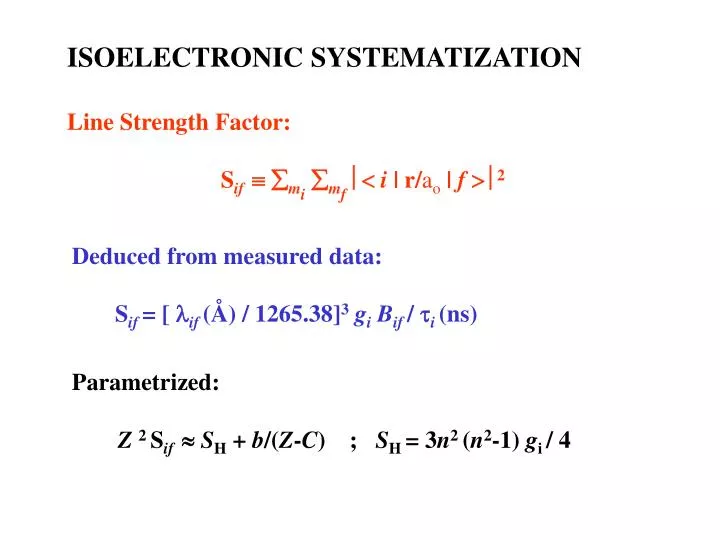
ISOELECTRONIC SYSTEMATIZATION Line Strength Factor: Sifmi mf i | r/ao | f 2 Deduced from measured data: Sif = [ if (Å) / 1265.38]3giBif/ i (ns) Parametrized: Z 2 SifSH + b/(Z-C) ; SH = 3n2 (n2-1) gi / 4
Singlet-Triplet Mixing nsnp levels RES INT
sp 1 and 2 free parameters: Wolfe, PR 41, 443 (1932) (spin-other-orbit) King & VanVleck, PR 56, 464 (1939) (spin dep. radial wave fctn.)
Alkaline-earthlike sequences
Radioactive 5670
All applications to here are n = 0 resonance transitions: Alkali-metallike ns – np Alkaline-earthlike ns2 – nsnp Are these data-based semiempirical methods also applicable to other types of transitions? Yes, but there are no data! Lifetime data exist, but branching fraction data are essentially non-existent for multiply charged ions Exceptions:
Differential Lifetime Measurements
Determination of branching fractions: Requires intensity calibration of detection apparatus as a function of wavelength Standard lamps: continuum radiation fixed in laboratory beam light Doppler shifted Line standards available in Visible, but not UV Need in-beam ions with known intensity ratios
S II : (Å) 907, 911, 913 1053, 1056 1167, 1173