Download
1 / 10
100 likes | 212 Vues
This overview of Kinetic Molecular Theory explains the behavior of matter based on the movement of particles. It discusses five fundamental rules: the constant motion of molecules, how energy and attraction affect particle speed in solids, liquids, and gases, and the influence of thermal energy on molecular motion. The physical states of matter are delineated by their volume and shape: solids have fixed shapes and volumes, liquids take the shape of their containers but have fixed volumes, and gases have neither fixed shape nor volume, making them flexible and compressible.

E N D
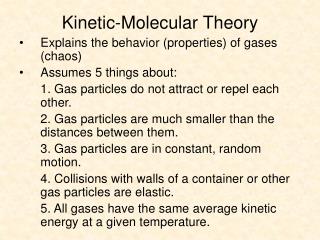
Kinetic Molecular Theory Part #2
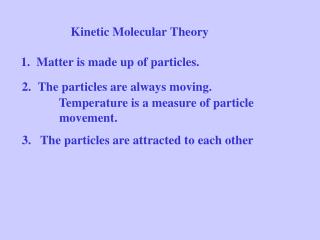
Rule #1 • All matter is made up of particles (molecules) that are constantly moving. (Movement like vibration in solids, and flying around freely, like in a gas)
Rule #2 • The molecules of matter move at different speeds depending on their state, their energy level, and their molecular attraction. • Solids – Low energy – High attraction ( high density) • Liquids – More energy than solids – Looser attraction (less density) • Gases – More energy than liquids – Bond/ attraction completely broken/ free. (low density)
Rule #3 • The amount of thermal (heat) energy you apply to a state of matter affects the amount of kinetic (physical) energy the molecules have. • The more heat you put on particles, the more they move around. • The colder you make particles the more they slow down.
Rule #4 • By adding to or taking away thermal energy (heat) from the different states of matter, you can change their state and the strength of their molecular attractions. • Example – Adding thermal energy to a solid makes it a liquid (melting). (looser attraction) • Example – Taking thermal energy away from a gas makes it a liquid. (condensation) (actually strengthens the attraction)
Rule #5 • The temperature of the matter is actually a measure of the energy contained in the substance.
Solids • Fixed Shape – Meaning it is in a shape that doesn’t change to what you put it in. • Fixed Volume – Means you can measure it’s size.
Liquids • Non-Fixed Shape – Takes the shape of whatever you put in. • Fixed Volume – Can be measured
Gases • Non-fixed shape – Can be compressed to fit wherever you want. • Non-fixed volume – Can be compressed to create whatever amount you want.