
SlideServe
Menu
Préférences
© SlideServe · v2026

Understanding the Kinetic Molecular Theory of Gases

cathleen-hall avatar
15 diapositives · 311 Views · Oct 30, 2014

The Kinetic Molecular Theory (KMT) explains the behavior of gases by outlining how gas particles are in constant motion, have negligible volume, and collide elastically with container walls, resulting in pressure. It emphasizes that gas particles exert no forces on each other and that their average kinetic energy correlates directly with temperature in Kelvin. The Root Mean Square (RMS) velocity connects these concepts, showing that at a given temperature, lighter gases move faster than heavier ones, leading to a distribution of particle speeds that increases with temperature.
Understanding the Kinetic Molecular Theory of Gases - slide 1
01 / 15Understanding the Kinetic Molecular Theory of Gases
1 / 17

Télécharger la présentation

Understanding the Kinetic Molecular Theory of Gases
Une image / un lien ci-dessous est fourni (tel quel) pour télécharger la présentation

Politique de téléchargement : le contenu du site vous est fourni TEL QUEL pour votre information et votre usage personnel ; il ne peut être vendu, concédé sous licence ni partagé sur d’autres sites sans l’accord de son auteur.Le contenu vous est fourni TEL QUEL, pour votre information et votre usage personnel uniquement. Téléchargez la présentation en cliquant sur ce lien. Lors du téléchargement, si vous ne parvenez pas à télécharger une présentation, l’éditeur a peut-être supprimé le fichier de son serveur.Pendant le téléchargement, si vous ne parvenez pas à obtenir une présentation, le fichier a peut-être été supprimé par l’éditeur.

F I N

Plus de contenu associé

Transcription de la présentation
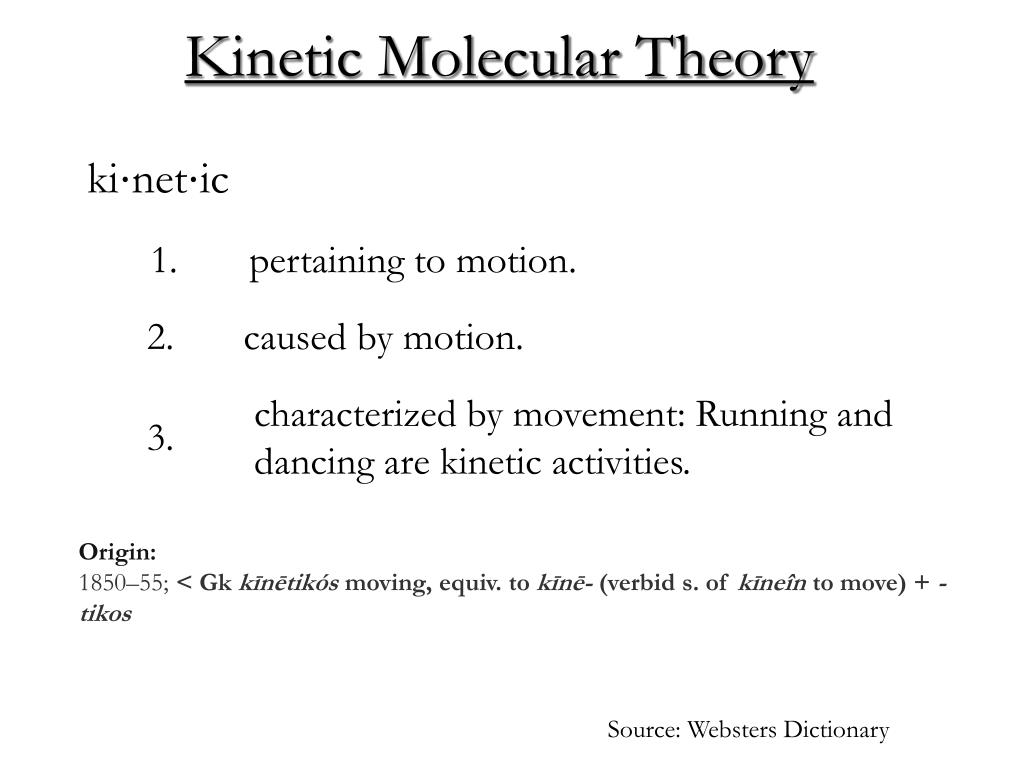
  1. Kinetic Molecular Theory ki⋅net⋅ic Origin: 1850–55; < Gk kīnētikós moving, equiv. to kīnē- (verbid s. of kīneîn to move) + -tikos Source: Websters Dictionary

  2. So far we have considered “what happens,” but not “why.” • In science, “what” always comes before “why.”

  3. The Nature of Gases • Gases expand to fill their containers • Gases are fluid – they flow • Gases have low density • 1/1000 the density of the equivalent liquid or solid • Gases are compressible • Gases effuse and diffuse

  4. Kinetic Molecular Theory • Particles of matter are ALWAYS in motion • Volume of individual particles is  zero. • Collisions of particles with container walls cause the pressure exerted by gas. • Particles exert no forces on each other. • Average kinetic energy is proportional to Kelvin temperature of a gas.

  5. Postulates of the Kinetic Molecular Theory 1) The particles are so small compared with the distances between them that the volume of the individual particlescan be assumed to be negligible (zero).

  6. Postulates of the Kinetic Molecular Theory • The particles are in constant motion. • The collisions of the particles with the walls of the container are the cause of the pressure exerted by the gas.

  7. Postulates of the Kinetic Molecular Theory 4)The particles are assumed to exert no forces on each other; they are assumed neither to attract nor to repel each other and engage in elastic collisions.

  8. Postulates of the Kinetic Molecular Theory 5) The average kinetic energy of a collection of gas particles is assumed to be directly proportional to the Kelvin temperature of the gas.

  9. Kinetic Energy of Gas Particles At the same conditions of temperature, all gases have the same average kinetic energy. This calc is on REF SHEET. m = mass v = velocity  At the same temperature, small molecules move FASTER than large molecules

  10. Root Mean Square Velocity • Avg velocity of a gas is actually the avg of the squares of the particle velocities. • The square root of this is the root mean square velocity

  11. Root Mean Square Velocity – Maxwell-Boltzmann Distribution Curve

  12. What does this tell us? • At any given temp, gas mlcls have both high & low speeds (think ppl in hallway) • As temp incrs, the distribution of speeds is found to be across a wider range • As temp incrs, a greater # of mlcls are traveling faster. @ 2273K, mcls traveling 1500-3000m/s, but at 273K, they can’t be in that range.

  13. RMS Velocity • The RMS velocity, temperature, & molar mass are related. • You won’t have to use the calculation, BUT. • Know that RMS is dependent upon molar mass • Heavier particles move more slowly • Know that RMS is dependent upon temperature • Particles at high temps move more quickly

  14. Root Mean Square Velocity R = 8.3145 J/K·mol (J = joule = kg·m2/s2) T = temperature of gas (in K) M = mass of a mole of gas in kg • Final units are in m/s.

  15. What does this show?