Reference Angles in Trigonometry
Learn about reference angles, how to find them in different quadrants, and their significance in trigonometric functions. Explore examples and the Reference Angle Theorem in this comprehensive guide.

Reference Angles in Trigonometry
E N D
Presentation Transcript
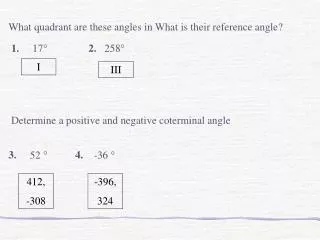
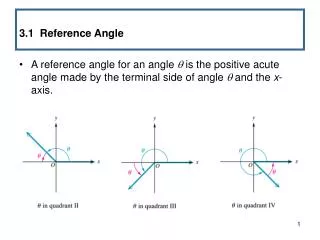
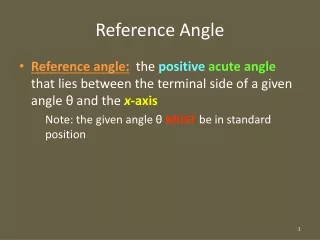
Reference Angle • Reference angle: the positiveacute angle that lies between the terminal side of a given angle θ and the x-axis Note: the given angle θ MUST be in standard position
Reference Angle Examples – Quadrant I Note that both θ and the reference angle are 60°
Reference Angle Summary • Depending in which quadrant θ terminates, we can formulate a general rule for finding reference angles: • For any positive angle θ, 0° ≤ θ ≤ 360°: • If θЄ QI: Ref angle = θ • If θ Є QII: Ref angle = 180° – θ • If θ Є QIII: Ref angle = θ – 180° • If θЄ QIV: Ref angle = 360° – θ
Reference Angle Summary (Continued) • If θ > 360°: • Keep subtracting 360° from θ until 0° ≤ θ ≤ 360° • Go back to the first step on the previous slide • If θ < 0°: • Keep adding 360° to θ until 0° ≤ θ ≤ 360° • Go back to the first step on the previous slide
Reference Angle (Example) Ex 1: Draw each angle in standard position and then name the reference angle: a) 210° b) 101° c) 543° d) -342° e) -371°
Relationship Between Trigonometric Functions with Equivalent Values • Consider the value of cos 60° and the value of cos 120°: cos 60° = ½ (Should have this MEMORIZED!) cos 120° = -½ (From Definition I with and 30° – 60° – 90° triangle)
Relationship Between Trigonometric Functions with Equivalent Values (Continued) • What is the reference angle of 120°? 60° • Need to adjust the final answer depending on which quadrant θ terminates in: 120° terminates in QII AND cos θ is negative in QII • Therefore, cos 120° = -cos 60° = -½ • The VALUES are the same – just the signs are different!
Reference Angle Theorem • Reference Angle Theorem: the value of a trigonometric function of an angle θ is EQUIVALENT to the VALUE of the trigonometric function of its reference angle • The ONLY thing that may be different is the sign • Determine the sign based on the trigonometric function and which quadrant θ terminates in • The Reference Angle Theorem is the reason why we need to memorize the exact values of 30°, 45°, and 60° only in Quadrant I!
Reference Angle Summary • Recall: • For any positive angle θ, 0° ≤ θ ≤ 360° • If θЄ QI: Ref angle = θ • If θ Є QII: Ref angle = 180° – θ • If θ Є QIII: Ref angle = θ – 180° • If θЄ QIV: Ref angle = 360° – θ
Reference Angle Summary (Continued) • If θ > 360°: • Keep subtracting 360° from θ until 0° ≤ θ ≤ 360° • Go back to the first step • If θ < 0°: • Keep adding 360° to θ until 0° ≤ θ ≤ 360° • Go back to the the first step
Reference Angle Theorem (Example) Ex 2: Use reference angles to find the exact value of the following: a) cos 135° b) tan 315° c) sec(-60°) d) cot 390°
Approximating Angles (Continued) • To circumvent this problem, we can use reference angles: • Find the reference angle that corresponds to the given value of a trigonometric function: • Recall that a reference angle is a positive acute angle which terminates in QI • Because cos θ and sin θ are both positive in QI, always use the POSITIVE value of the trigonometric function • Apply the reference angle by utilizing the quadrant in which θ terminates
Approximating Angles (Example) Ex 3: Use a calculator to approximate θ if 0° < θ < 360° and: a) cos θ = 0.0644, θЄ QIV b) tan θ = 0.5890, θЄ QI c) sec θ = -3.4159, θЄ QII d) csc θ = -1.7876, θЄ QIII