Download
1 / 13
130 likes | 255 Vues
This paper examines the Drell-Levy-Yan (DLY) relation, which connects fragmentation functions with distribution functions in nucleons. By employing spectral representations and the reduction formula, we derive two methods to illustrate the DLY relation, revealing essential characteristics of quark distributions within hadrons. Our numerical calculations utilize the Nambu-Jona-Lasinio (NJL) model to account for valence and sea quark contributions and the effects of pion clouds. Results indicate that while the NJL model accurately describes distributions for x < 1, challenges arise for fragmentation functions at x > 1. We discuss possible reasons for this discrepancy.

E N D
On the Drell-Levy-Yan Relationfor Fragmentation Functions T. Ito, W.Bentz(Tokai Univ.) K.Yazaki (Tokyo Woman’s University, and RIKEN) A.W.Thomas (JLab)
DLY Relation: Case of nucleon Using spectral representations (or the reduction formula), one can show the following relations (“Crossing of nucleon line”): local field operator(fermion type: + sign, boson type: - sign); Choose (i) (current operator) in hadronic tensor, (ii) (quark field) in operator definition of quark distribution → DLY relation can be shown in 2 ways:
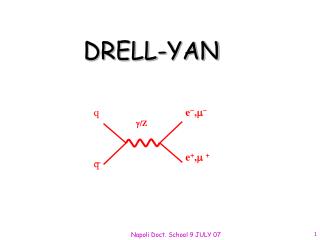
DLY Relation: (i) hadronic tensor Hadronic tensors for e p → e’ X, and e+ e- → p X Crossing gives: for bosons (fermions). Then the DLY relation follows (0 < z < 1): distribution of quark (q) in hadron (h); fragmentation of q into h
DLY Relation: (ii) operator definition Crossing gives again the DLY relation for bosons (+) and fermions (-). (Here 0 < z < 1) origin of factor 1/6: Average over quark spin and color. Important result: For boson case, must not vanish at x = 1 ! The “generalized distribution” must be positive everywhere:
Numerical calculations: valence quarks Use the NJL model and a simple valence quark picture to calculate the generalized distribution function from the Feynman diagrams (nucleon case) Nucleon ≡ quark + scalar diquark Use pole approximation for diquark propagator. Regularization: Transverse cut-off. Parameters: Constituent quark mass M = 0.4 GeV, cut-off ΛTr = 0.407 GeV.
…… Numerical calculations: sea quarks Include sea quark distributions (or: “unfavored” fragmentation process of sea quarks) as an effect of pion cloud around constituent quarks. For the generalized distribution function, we use the convolution formalism to evaluate diagrams like Use pole approximation for diquark and pion propagators; on-shell (parent quark) approximation in the convolution integral.
Generalized uV distribution in proton Results at the NJL model scale Red line: without pion cloud Black line:with pion cloud
Generalized uV distribution in π+ Results at the NJL model scale Red line: without pion cloud Black line:with pion cloud
uV distribution in proton Results at Red line: without pion cloud Black line:with pion cloud Blue line:Empirical (MRST)
uV fragmentation into proton Results at Red line: without pion cloud Black line:with pion cloud Blue line:Empirical (M.Hirai et al).
uV distribution in π+ Results at Red line: without pion cloud Black line:with pion cloud Blue line:Empirical (P.J.Sutton et al) At x = 1: Input artificially set to zero, in order to use the Q2 evolution program.
uV fragmentation into π+ Results at Red line: without pion cloud Black line:with pion cloud Blue line:Empirical (M.Hirai et al). At z = 1: Input artificially set to zero, in order to use the Q2 evolution program.
Conclusions DLY relation is based on crossing symmetry, and is very general. It expresses the fragmentation function by the distribution function in the “unphysical” region x > 1. Simple chiral quark model describes the distributions (x < 1) very well, but fails for the fragmentation functions (x > 1) by factors of 10~100. • Possible reasons for failure: • Point NJL vertex functions • On-shell approximation in convolution integrals • What else ??? Thanks to: S.Kumano, M.Miyama, M.Hirai for Q2 evolution; M.Strattman for discussions.