Download
1 / 29
300 likes | 436 Vues
Discover the transformative role of leadership in nursing at the 15th Annual Conference hosted by Katrina Bickerstaff and Armi Holcomb. This session explores essential leadership values, characteristics of inspirational leaders, and their impact on nursing retention. Learn how effective leadership is not defined by titles or seniority, but rather by the ability to inspire, encourage, and foster teamwork across diverse generational perspectives. Engage with practical techniques for bridging generational differences and creating an inclusive and motivating work environment.

E N D
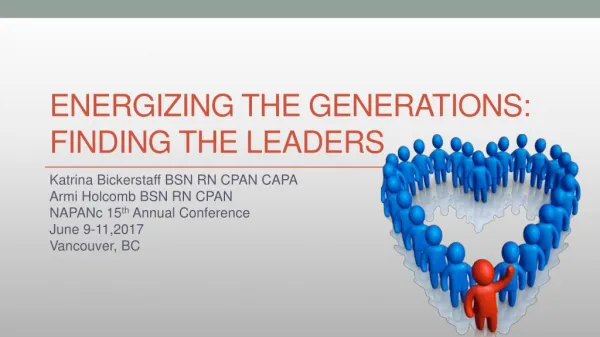
Energizing the Generations: Finding the Leaders Katrina Bickerstaff BSN RN CPAN CAPA Armi Holcomb BSN RN CPAN NAPANc 15th Annual Conference June 9-11,2017 Vancouver, BC
Objectives List the values of leadership Describe the assets of an inspirational leader Identify the importance of leadership on nursing retention
What is Leadership? • Leadership has nothing to do with seniority or one’s position in the hierarchy of a company • Leadership has nothing to do with titles • Leadership has nothing to do with personal attributes • Leadership isn’t management
So What is Leadership? DEFINITION: Leadership is a process of social influence, which maximizes the efforts of others, towards the achievement of a goal What Is Leadership?. http://www.forbes.com/sites/kevinkruse/2013/04/09/what-is-leadership/2/#32f61a1de825.
Why Do We Need Leaders • Leadership is an attitude • Leaders encourages us to realize our real potential • Leaders make us confident • Leaders invoke the sense of responsibilities • Leaders love their subordinates grow
Leadership Values • Optimistic • Broad minded • Caring • Competent • Courageous • Innovative • Forward looking • Decisive • Dependable • Supportive • Determined • Loyal • imaginative • Trustworthy, • Willing to accept responsibility • Able to communicate effectively • Integrity • Inspiring • Teamwork/collaboration • Diversity • Self controlled • Independent
http://theleadershiptrainingworkshop.com/2016/05/important-characteristics-of-admired-leaders/http://theleadershiptrainingworkshop.com/2016/05/important-characteristics-of-admired-leaders/
Lessons from the GeeseImportance of Achieving GoalsImportance of TeamworkImportance of SharingImportance of Empathy and SharingImportance of Encouragement
Are You a Leader or a Follower • John Quincy Adams, 6th President of the United States, defined leadership as: “If your actions inspire others to dream more, learn more, do more and become more, you are a leader.”
Effective and Inspirational Nursing Leadership • Dream • Learn • Do • Become
The Inspirational Leader • Having the right perspective • Constructive feedback • Possess the right spirit • Setting goals • Delegation of responsibilities • Creating an enjoyable atmosphere
Characteristics of a Successful Leadership Style • Choose to lead • Be the person others choose to follow • Provide vision for the future • Provide inspiration • Make other people feel important and appreciated • Live your values • Behave ethically • Set the pace through your expectations and example • Establish an environment of continuous improvement • Provide opportunities for people to grow • Care and act with compassion
Professional Practice of a Leader • Attitude • Appropriate Dialogue • Professional Dress
Managing Generational Attitudes Towards Leadership Values, Attitudes, Beliefs and Behaviors Patterns are learned • parents • teachers • peers • society
Managing Generational Attitudes Towards Leadership • The heart of the challenge are the very differences of the generations • These differences impact how we manage and lead • How we interact with each other everyday
Four Makes a Party Right? • Pew Research Center (May 2015) • US Labor Force showing how Millennials have surpassed Generation X as the largest generation working in America • First time in history • Four generations working alongside each other • Silent Generation, • Baby Boomers, • Generation X • Millennial
Five Techniques For Managing Generational Differences Focus on goals and set clear expectations • Each generation approaches their work differently, each providing strengths the other do not posses Mentoring and Inclusion • Encourage each generation to mentor the other Break the bonds of tradition. • If there is a better way to do something, take the suggestion
Five Techniques For Managing Generational Differences Show employees the future • Tell them where the organization is going, how they fit in, and how to prepare. Encourage balance • Employees of all ages place a high value on balancing their work and personal lives
Professional Practice Mentoring • Be available • Promote • Embrace with enthusiasm • Engage students • Be that “go to” person • Easily approachable • Share knowledge Autonomy • Take responsibility for practice • Anticipate • Be proactive • Advocate • Collaborate easily with all
Professional Leadership Qualities: • Lead by example • Engage peers • Promote professional behavior • Promote involvement in specialty • Model the way
In Conclusion Leadership is more about vision than precision • more about relationships than results • more about processes than structures • more about taking risks than security • more about cooperating than winning • more about effectiveness than efficiency • more about setting examples than getting quick results • more about long-term learning than short-term conclusions • more about asking the right questions than giving the right answers
http://www.brainyquote.com/quotes/quotes/t/tompeters382508.htmlhttp://www.brainyquote.com/quotes/quotes/t/tompeters382508.html