SlideServe
Menu
Préférences
© SlideServe · v2026

Parallel Circuits in Electronics: Characteristics and Calculations

carron avatar
19 diapositives · 851 Views · Jan 01, 2020

Learn about parallel circuits, including the characteristics related to voltage and currents. Discover how to calculate resistance in each branch using Ohm's law and determine total resistance. Explore common mistakes and the special case of equal resistances in parallel circuits.
Parallel Circuits in Electronics: Characteristics and Calculations - slide 1
01 / 19Parallel Circuits in Electronics: Characteristics and Calculations
1 / 17

Télécharger la présentation

Parallel Circuits in Electronics: Characteristics and Calculations
Une image / un lien ci-dessous est fourni (tel quel) pour télécharger la présentation

Politique de téléchargement : le contenu du site vous est fourni TEL QUEL pour votre information et votre usage personnel ; il ne peut être vendu, concédé sous licence ni partagé sur d’autres sites sans l’accord de son auteur.Le contenu vous est fourni TEL QUEL, pour votre information et votre usage personnel uniquement. Téléchargez la présentation en cliquant sur ce lien. Lors du téléchargement, si vous ne parvenez pas à télécharger une présentation, l’éditeur a peut-être supprimé le fichier de son serveur.Pendant le téléchargement, si vous ne parvenez pas à obtenir une présentation, le fichier a peut-être été supprimé par l’éditeur.

F I N

Plus de contenu associé

Transcription de la présentation
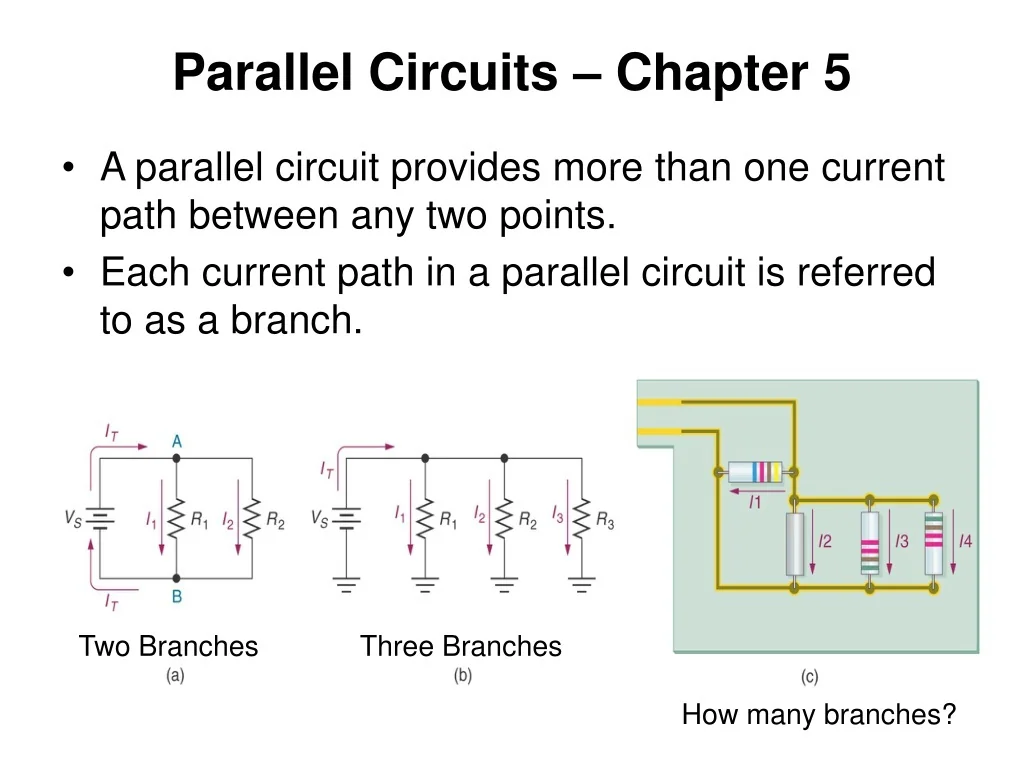
  1. Parallel Circuits – Chapter 5 • A parallel circuit provides more than one current path between any two points. • Each current path in a parallel circuit is referred to as a branch. Two Branches Three Branches How many branches?

  2. Parallel Circuit Characteristics • Voltage and Current Values • Voltage is the same across all components (a) No parallel branches (b) V1 = V2 = VS

  3. Parallel Circuit Characteristics • Current Characteristics • Source current is the sum of all branch currents where In = the current through the nth branch in the circuit

  4. The total current in the circuit is IT = I1 + I2 + I3 IT = 5mA + 10mA + 20mA = 35mA

  5. Parallel Circuit Characteristics • Voltage and Current Values • Current through each branch is determined by the source voltage and the resistance of the branch.

  6. TEAM ACTIVITY Use Ohm’s law to calculate the resistance in each branch.

  7. TEAM ACTIVITY

  8. TEAM ACTIVITY Use Ohm’s law to calculate the total resistance.

  9. TEAM ACTIVITY

  10. TEAM ACTIVITY Calculate

  11. Summary

  12. Common Mistake

  13. TEAM ACTIVITY

  14. TEAM ACTIVITY

  15. Special Case – Equal Resistances • When any number of equal resistances are connected in parallel, the total resistance is equal to the value of one resistor divided by the number of branches Shorthand notation for parallel

  16. Special Case – Equal Resistances Shorthand notation for parallel

  17. Adding Additional Branches • The addition of a parallel branch decreases the resistance of the circuit • single branch in (a) draws 5mA from the source • additional branch in (b) increases the current drawn from the source to 10mA

  18. TEAM ACTIVITY Determine the branch currents and the total current for each circuit. Check with MultiSim.