Exploration of Evolving Networks: Size and Density Effects on Node Discovery
10 likes | 147 Vues
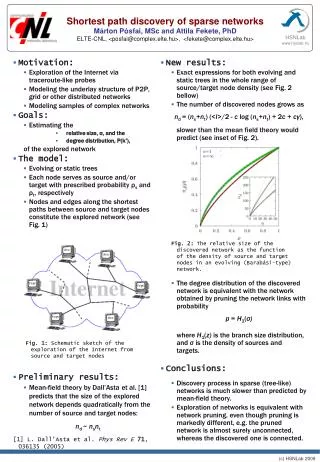
This study investigates the exploration of evolving (Barabási-type) networks through traceroute-like probes, focusing on the relationship between source and target node density and the size of the discovered network. We derive exact expressions for node discovery in both evolving and static trees, revealing that the growth of discovered nodes is slower than mean-field theory predictions. The findings have implications for modeling P2P systems and understanding the underlying structures of complex networks. Our results emphasize the nuanced dynamics of network exploration and the characteristics of discovered versus pruned networks.


Exploration of Evolving Networks: Size and Density Effects on Node Discovery
E N D
Presentation Transcript
Fig. 2: The relative size of the discovered network as the function of the density of source and target nodes in an evolving (Barabási-type) network. Fig. 1: Schematic sketch of the exploration of the Internet from source and target nodes Shortest path discovery of sparse networksMárton Pósfai, MSc and AttilaFekete, PhDELTE-CNL, <posfai@complex.elte.hu>, <fekete@complex.elte.hu> • New results: • Exact expressions for both evolving and static trees in the whole range of source/target node density (see Fig. 2 bellow) • The number of discovered nodes grows as nd = (ns+nt)(<l>/2 - c log (ns+nt) + 2c + cγ), slower than the mean field theory would predict (see inset of Fig. 2). • Motivation: • Exploration of the Internet via traceroute-like probes • Modeling the underlay structure of P2P, grid or other distributed networks • Modeling samples of complex networks • Goals: • Estimating the • relative size, σ, and the • degree distribution, P(k’), of the explored network • The model: • Evolving or static trees • Each node serves as source and/or target with prescribed probability ρs and ρt, respectively • Nodes and edges along the shortest paths between source and target nodes constitute the explored network (see Fig. 1) • The degree distribution of the discovered network is equivalent with the network obtained by pruning the network links with probability p = H1(σ) where H1(z) is the branch size distribution, and σ is the density of sources and targets. • Conclusions: • Discovery process in sparse (tree-like) networks is much slower than predicted by mean-field theory. • Exploration of networks is equivalent with network pruning, even though pruning is markedly different, e.g. the pruned network is almost surely unconnected, whereas the discovered one is connected. • Preliminary results: • Mean-field theory by Dall’Asta et al. [1] predicts that the size of the explored network depends quadratically from the number of source and target nodes: nd ~ nsnt [1] L. Dall’Asta et al. Phys Rev E71, 036135 (2005)