Exploring Chemical Reactions and Equations: Balancing, Matter Conservation, and Symbolic Representations
Understand the differences between chemical and physical changes, explore equations for reactions like baking a cake or burning wood, and learn about the law of conservation of matter. Practice balancing equations using word problems and the coefficient tally method.

Exploring Chemical Reactions and Equations: Balancing, Matter Conservation, and Symbolic Representations
E N D
Presentation Transcript
Chemical vs Physical changes • Chemical rnx (reaction) Baking a cake or burning wood Vs Water to Ice What is Water to Vapor (boiling water)
Law of conservation of matter • This law states matter can neither be created or destroyed only converted.
Word equation • (all words) Solid ammonium chromate when heated decomposes into ammonia gas and solid Chromate while giving off energy. (NH4)2(CrO4)(s) (NH4)(g) + CrO4 (s)
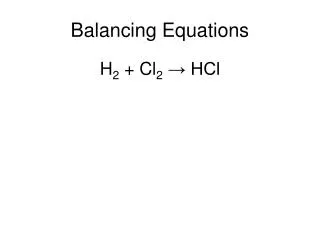
CH4 (g) + O2 (g) H2O (l) + CO2(g) The break down: Symbols “+” separates products or separates reactants yield, make; separates products from reactants. Points to product. (direction of rnx) g= gas or vapor l=pure liquid aq= aqueous solution; dissolved into water; all acids are aqueous. s= solid
Word Problems Nitrogen gas reacts with hydrogen gas form ammonia vapor. N2 (g) + H2 (g) ___ (g) N2 (g) + H2 (g) NH3(g)
We need coefficients to help balance equations N2(g) + 3H2 (g) 2NH3(g) What is special about the coefficient in front of the Nitrogen gas? Coefficients
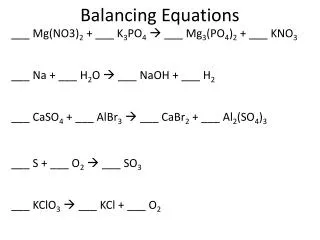
Tally method CH4 + 2O2 CO2 +2H2O C=1 2(O=2)=4 C=1 2(H=2)=4 H=4 O=2 2(O=1)=2 O=4
In partners CuSO4 + Al Al2(SO4)3 + Cu OR Na + H2O NaOH + H2 **Hint----- Balance Hydrogen's Last
CuSO4 + Al Al2(SO4)3 + Cu Cu=1 Cu=1 S=1 S=3 O=4 O=12 Al=1 Al=2 3CuSO4 + 2Al Al2(SO4)3 + 3Cu
Na + H2O NaOH + H2 Na=1 Na=1 O=1 O=1 H=2 H=3 2Na + 2 H2O 2NaOH + H2