Download
1 / 5
50 likes | 166 Vues
In this engaging lab activity, students explore the mechanisms of cell transport, including passive, active, and bulk transport. Through observation of beakers containing eggs, they will answer questions related to osmosis and membrane permeability. The homework assignments challenge students to apply their knowledge of osmosis in real-life scenarios, such as the effects on aquatic life when exposed to different environments. By completing a Venn diagram for active and passive transport and analyzing exocytosis processes, students deepen their understanding of cellular transport dynamics.

E N D
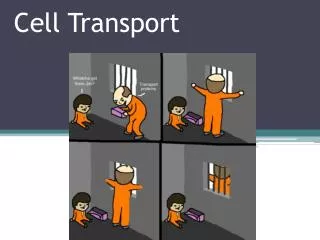
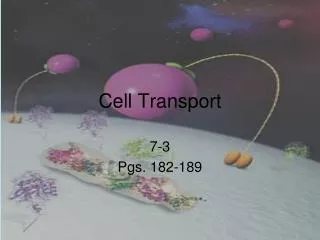
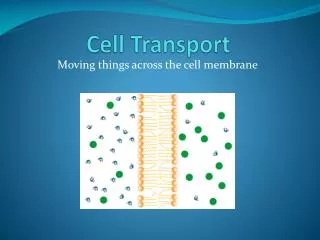
Cell Transport Moving things across the cell membrane
Warm Up • Pick a lab station and bring your warm-up sheet to it. • Take a minute to observe the two beakers. *You may gently touch the eggs. DO NOT PICK UP THE EGGS • Answer the four questions listed at the lab station. TURN IN YOUR HW: CELL MEMBRANE
Objectives • Students will be able to describe passive transport, active transport, and bulk transport. • Students will be able to predict the flow of water and other substances across a semipermeable membrane.
Homework (worksheet) • 1. What would happen if you took yourgoldfish (freshwater fish) to Ocean City for the summer and decided to let it go in the ocean? Explain in terms of osmosis, hypertonic, hypotonic and such. • 2. You decide to take the baby shark you caught in Ocean City and put it in your swimming pool. Explain as above. • 3. Compare active and passive transport using a Venn diagram. • 4. Describe, step by step, the process of exocytosis. Begin by describing how cellular materials are packaged into vesicles.