
Course content
E N D
Presentation Transcript
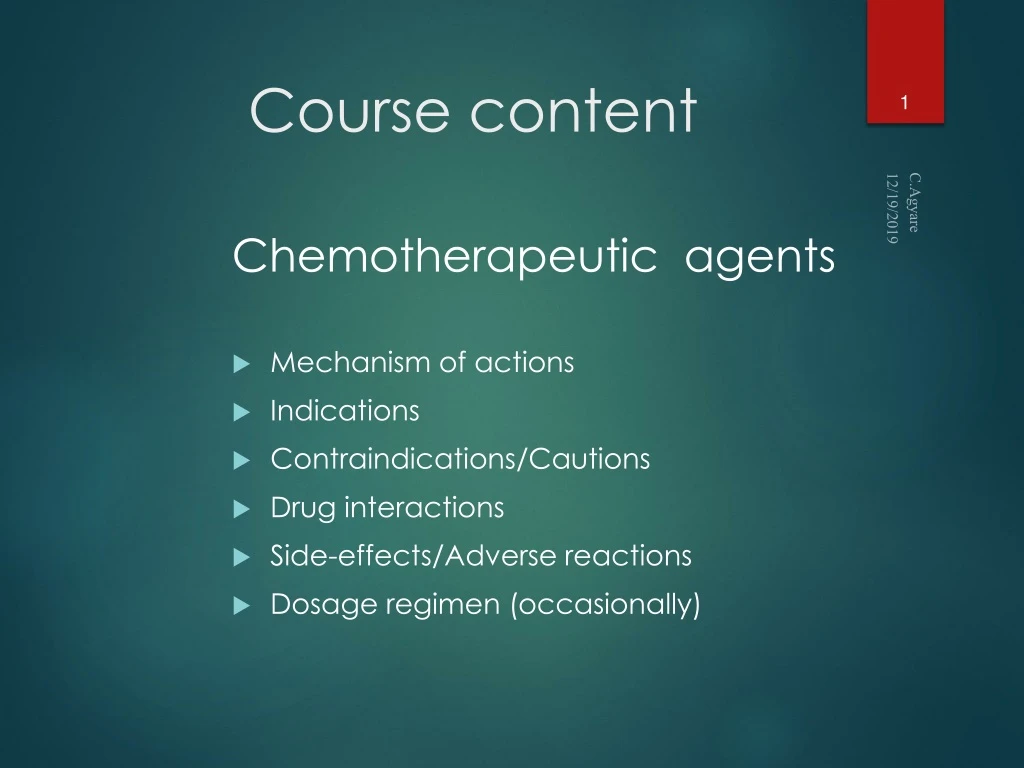
Course content Chemotherapeutic agents • Mechanism of actions • Indications • Contraindications/Cautions • Drug interactions • Side-effects/Adverse reactions • Dosage regimen (occasionally) C.Agyare
Reference Books • Pharmacology by Rang, Dale, Ritter, Gardner • Clinical Pharmacology textbooks • British National Formulary (BNF) C.Agyare
Antifungal agents C.Agyare
Most fungi are commensals or live in the environment. • But increasing incidence and severity of human fungal infections • Fungal infections are termed mycoses and in Generally can be divided into: • 1) Superficial infections • 2) Cutaneous infections • 3) Sub-cutaneous infections • 4) Systemic infections C.Agyare
FUNGAL INFECTIONS C.Agyare blastomycosis candidiasis histoplasmosis mucorymycosis ringworm
Factors increasing incidence and severity of human fungal infections • Widespread use of broad-spectrum antibiotics (antimicrobial drugs) • Reduced immune responses caused by AIDS • Use of immunosuppressant drugs • Administration of anticancer drugs (cancer chemotherapy) • Chronic use of steroids (spreading of an infection) C.Agyare
FUNGAL INFECTIONS . Fungal infections are usually more difficult to treat than bacterial infections • Fungal organisms grow slowly • Fungal infections often occur in tissues that are poorly penetrated by antimicrobial agents Eg: devitalized or avascular tissues C.Agyare
ANTIFUNGAL AGENTS • The Azoles • Griseofulvin • Flucytosine • The polyenes • Echinocandin antifungals (new) C.Agyare
Antifungalsdamaging permeabilityof the cell membrane • Imidazoles:Bifonazole, Clotrimazole, Econazole, Ketoconazole, Miconazole • Triazoles:Fluconazole, Itraconazole, Voriconazole • Allylamines:Terbinafine, Naftifine • Morpholines:Amorolfine • Thiocarbamates:Tolciclate, Tolnaftate • Substituted pyridones: Ciclopirox • Polyene antibiotics:Amphotericin B, Nystatin C.Agyare
II. Antifungals inhibiting cell wall synthesis • Echinocandins: Caspofungin, anidulafungin and micafungin • III. Antifungals inhibiting synthesis of nucleic acids • Flucytosine • Griseofulvin????? C.Agyare
AZOLES • Comprise the imidazoles and triazoles C.Agyare
Imidazoles: • MiconazoleBifonazole • Ketoconazole Butoconazole • ClotrimazoleEconazole • FenticonazoleTioconazole • IsoconazoleOxiconazole • SertaconazoleSulconazole • Triazoles: • Fluconazole • Itraconazole • Ravuconazole • Posaconazole • Voriconazole C.Agyare
Mechanism of action • Azoles inhibit the enzyme cytochrome P450 14α-demethylase. This enzyme converts lanosterol to ergosterol, and is required in fungal cell membrane synthesis C.Agyare
Azoles • Reduced fungal membrane ergosterolconcentrations result in damaged, leaky cell membranes • Azoles inhibiting cytochrome P450 enzymes (inhibits biosynthesis of adrenal and gonadal steroid hormones) • The toxicity of these drugs depends on their relative affinities for mammalian and fungal cytochrome P450 enzymes. • The triazoles tend to have fewer side effects, better absorption, better drug distribution in body tissues, and fewer drug interactions. C.Agyare
KETOCONAZOLE • Spectrum of activity includes ٭Candida species ٭Coccidioides immitis ٭Cryptococcus neoformans * Dermatophytes & Pityriasis versicolor C.Agyare
Pharmacokinetics • An acid environment is necessary for ketoconazole absorption • Administration of food with ketoconazole appears to increase absorption due possibly to: 1) increased bile secretions 2) delayed gastric emptying • Does not cross the intact blood-brain barrier except in meningitis. • Urinary concentrations of ketoconazole are usually low, but vaginal and vaginal tissue concentrations correlate with those in serum. C.Agyare
KETOCONAZOLE Metabolized through • oxidation, • dealkylation, • aromatic hydroxylation. Excreted into the bile, faeces and the urine • Bile • Faeces • Urine C.Agyare
Side effects • Impotence • Gynaecomastia • Reduced sperm count • Decreased libido • Hepatotoxicity • Nausea/vomiting • Pruritis • Dizziness • Photophobia C.Agyare
Contraindications/Precautions • Achlorhydria • Hypochlorhydria • Alcoholism • Breast-feeding • Children • Hepatic disease • Pregnancy C.Agyare
Drug interactions • Antacids • H2 blockers • Omeprazole • Isoniazid • Corticosteroids • Ethanol • Phenytoin • Rifampicin • Astemizole • Amphotericin B C.Agyare
Miconazole, Econazole, Clotrimazole • Bioavailability is low when administered orally • Usually used topically. C.Agyare
Fluconazole • Does not require an acidic environment, as does ketoconazole, for GI absorption. • About 80 to 90% absorbed from GIT. • Thet1/2 of the drug is 27 to 37 h, permitting once-daily • dosing in patients with normal renal function. • Only 11% of the circulating drug is bound to plasma proteins. C.Agyare
Fluconazole • The drug penetrates widely into most body tissues eg CSF therefore effective for treating fungal meningitis. • About 80% of the drug is excreted unchanged in the urine. • Dosage reductions are required in the presence of renal insufficiency. • Alopecia and hepatic necrosis have been reported as adverse effects C.Agyare
Itraconazole • Lipophilic and water insoluble • Requires a low gastric pH for absorption. • Oral bioavailability is variable (20 to 60%). • It is highly protein bound (99%) • Metabolized in the liver and excreted into the bile. • Useful in the treatment of disseminated histoplasmosis in AIDS,nonmeningealblastomycosis and sporotrichosis C.Agyare
Itraconazole • Contraindicated in conditions of hepatic and renal impairment, pregnancy and breastfeeding mothers • Side effects include nausea, abdominal pain and rash. • Flatulence, constipation, menstrual disorders and alopecia may occur. C.Agyare
GRISEOFULVIN • Fermentation product of Penicilliumgriseofulvum • Mode of action not exactly understood but involves nucleic acid synthesis and cell mitosis • Dermatophyte infections of the skin, scalp, hair and nails • Infections where susceptible strains of Trichophyton, Microsporum and Epidermaphyte are implicated. • Griseofulvinalso is deposited in keratin cells on the surface of the skin making it difficult for fungus to invade the skin and other tissues C.Agyare
Pharmacokinetics • Well absorbed after oral administration. • Presence of fat in the diet appears increase absorption of griseofulvin • Metabolized in the liver and then excreted in urine C.Agyare
Drug Interactions • Barbiturates ( e.g. Phenobarbitone) • Warfarin • Oestrogen • Progesterone preparations C.Agyare
Toxicity and Side Effects • Headache • Abdominal discomfort • Rashes • Fatigue, Dizziness (enhance effect of alcohol) • Confusion and impaired co-ordination C.Agyare
POLYENE ANTIFUNGALS Amphotericin B • Mechanism of Action: Destroys the integrity of cellular membrane of susceptible organism by binding to ergosterol • Active against most fungi and yeast • Treatment of systemic fungal infections. • Not absorbed from the gut • Given by IV infusion C.Agyare
Toxic Effects • Anorexia, Nausea, Vomiting, diarrhoea, epigastric pain • Headache, Muscle and Joint pain • Disturbances in renal and liver functions • Neurological and blood disorders C.Agyare
Clinical Uses • Drug of choice in most systemic mycoses • Candidiasis • Cryptococcosis • Aspergillosis • Mucormycosis. C.Agyare
Nystatin • Produced from Streptomyces noursei • Active against Candida albicans infections of skin and mucous membranes • Not absorbed when given by mouth • Its activity is affected by long exposure to light, and heat C.Agyare
Side Effects • Nausea • Vomiting and Diarrhoea (at high doses) • Oral irritation • Rashes (topical and vaginal forms) C.Agyare
Flucytosine (5-flucytosine, 5-FC) • Fluorinated purimidine related to fluouracil and floxuridine • An analogue of cytosine that was originally synthesized for possible use as an antineoplastic agent. • 5-FC is converted to 5-fluorouracil inside the cell by the fungal enzyme cytosine deaminase. • The active metabolite 5-fluorouracil interferes with fungal DNA synthesis by inhibiting thymidylatesynthetase. • Incorporation of these metabolites into fungal RNA inhibits protein synthesis. Indicated for :Crytococcusneoformans (Crytococcal), Candida infections (UTI’s) and Torulopsisglabrata C.Agyare
Pharmacokinetics • Rapidly and well absorbed in GI tract • Widely distributed in the body • Minimally bound to proteins • Approximately 80% excreted in the urine (unchanged) • Half-life 3-6 hours C.Agyare
Side Effects • Leukopenia • Thrombocytopenia • Rash • Nausea and vomiting • diarrhoea. • Severe enterocolitis • Confusion, headache, sedation C.Agyare
Drug Interactions • Amphotericin • Cytotoxics C.Agyare
Allylamines • Reversible noncompetitive inhibitors of the fungal enzyme squalene epoxidase, which converts squalene to lanosterol. • These agents exhibit fungicidal activity against dermatophytesand fungistatic activity against yeasts. • Naftifine is available for topical use only in the treatment of cutaneous dermatophyte and Candida infections. C.Agyare
Terbinafine • Dermatophyte infections of the nails and ringworm infections • Available for topical and systemic use • Lipophilic and highly binds to plasma protiens Cautions • Hepatic and renal impairment • Pregnancy • Breast feeding C.Agyare
Drug interactions • Rifampicin • Cimetidine • Famotidine C.Agyare
Side effects • Abdominal discomfort • Anorexia • Urticaria rash • Taste disturbance • Photosensitivity C.Agyare
ECHINOCANDIN ANTIFUNGALS • Mode of action: inhibit ß-(1,3) glucan synthesis, damaging fungal cell walls • no drug target in mammalian cells • Rapidly fungicidal against most Candida spp. • Fungistatic against Aspergillus spp. • Active against cyst form of Pneumocystis carinii. C.Agyare
Caspofungin Pharmacokinetics • Administration: IV • 96% plasma protein bound • Predominantly hepatic metabolism (hydrolysis and N-acetylation). • Distribution: urinary concentration low, CSF concentration expected to be low C.Agyare
Adverse effects • Fever • Hepatotoxicity • raised transaminases common in patients receiving caspofungin • hepatic necrosis in animals given large doses (5-8 mg/kg) • Headache • Phlebitis • Rash (infrequent) • Haemolysis may occur but clinically significant haemolysis is rare C.Agyare