
Establishing and Maintaining Stability and Continuity
E N D
Presentation Transcript
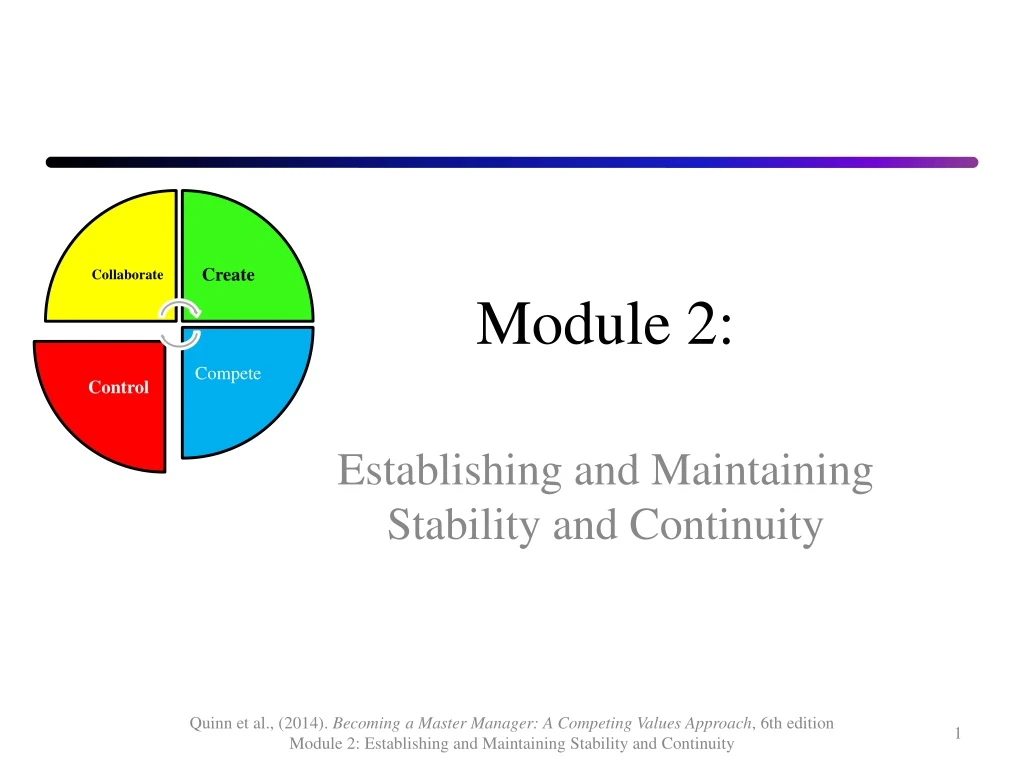
Module 2: Establishing and Maintaining Stability and Continuity Quinn et al., (2014). Becoming a Master Manager: A Competing Values Approach, 6th edition Module 2: Establishing and Maintaining Stability and Continuity
Agenda for Module 2 • Assumptions and Goals • Paradoxes • Competencies Internal Process Model Quinn et al., (2014). Becoming a Master Manager: A Competing Values Approach, 6th edition Module 2: Establishing and Maintaining Stability and Continuity
Internal Process Model Assumptions and Goals Quinn et al., (2014). Becoming a Master Manager: A Competing Values Approach, 6th edition Module 2: Establishing and Maintaining Stability and Continuity
Paradoxes of Control • Employees may resist or rebel • Attention to detail may overwhelm true goals • Daily activities may undermine new initiatives Quinn et al., (2014). Becoming a Master Manager: A Competing Values Approach, 6th edition Module 2: Establishing and Maintaining Stability and Continuity
Control Core Competencies • Organizing Information Flows • Working and Managing Across Functions • Planning and Coordinating Projects • Measuring and Monitoring Performance and Quality • Encouraging and Enabling Compliance Quinn et al., (2014). Becoming a Master Manager: A Competing Values Approach, 6th edition Module 2: Establishing and Maintaining Stability and Continuity
Managers who focus on internal control … • Know the details of activities in their units • Get the right people, at the right place, and at the right time • Plan and structure tasks to optimize workflows • Analyze data to evaluate performance • Rely on rules to guide behavior Quinn et al., (2014). Becoming a Master Manager: A Competing Values Approach, 6th edition Module 2: Establishing and Maintaining Stability and Continuity
Primary Tensions FLEXIBILITY INTERNAL FOCUS EXTERNAL FOCUS STABILITY Quinn e al., (2014). Becoming a Master Manager: A Competing Values Approach, 6th edition Module 2: Establishing and Maintaining Stability and Continuity
Organizing Information Flows Quinn et al., (2014). Becoming a Master Manager: A Competing Values Approach, 6th edition Module 2: Establishing and Maintaining Stability and Continuity
Using TRAF to Manage Information Flows F A T R Quinn et al., (2014). Becoming a Master Manager: A Competing Values Approach, 6th edition Module 2: Establishing and Maintaining Stability and Continuity
Prioritizing Action Items • Is it IMPORTANT? • If not, why are you doing it? • Is it URGENT? • If not now, will it become urgent in the future? Quinn et al., (2014). Becoming a Master Manager: A Competing Values Approach, 6th edition Module 2: Establishing and Maintaining Stability and Continuity
Communicating Clearly, Concisely, & Completely Quinn et al., (2014). Becoming a Master Manager: A Competing Values Approach, 6th edition Module 2: Establishing and Maintaining Stability and Continuity
Working and Managing Across Functions Accounting Manufacturing HR Marketing Quinn et al., (2014). Becoming a Master Manager: A Competing Values Approach, 6th edition Module 2: Establishing and Maintaining Stability and Continuity
Cross-Functional Teams Within Traditional Work Structures • Why use cross-functional teams? • What is so challenging about working across functions? • Is functional diversity always beneficial to cross-functional teams? • If working across functions is so great, why not change the organizational structure? Quinn et al., (2014). Becoming a Master Manager: A Competing Values Approach, 6th edition Module 2: Establishing and Maintaining Stability and Continuity
Key Guidelines for Managing Cross-Functionally Quinn et al., (2014). Becoming a Master Manager: A Competing Values Approach, 6th edition Module 2: Establishing and Maintaining Stability and Continuity
Picking People Who Lift Others Energizing Relationships Quinn et al., (2014). Becoming a Master Manager: A Competing Values Approach, 6th edition Module 2: Establishing and Maintaining Stability and Continuity
Planning and Coordinating Projects Quinn et al., (2014). Becoming a Master Manager: A Competing Values Approach, 6th edition Module 2: Establishing and Maintaining Stability and Continuity
Project Management 101 Project Characteristics • A series of activities and tasks with an objective, a defined time frame, funding limits, and consumption of resources Processes Quinn et al., (2014). Becoming a Master Manager: A Competing Values Approach, 6th edition Module 2: Establishing and Maintaining Stability and Continuity
Project Planning & Monitoring Tools • Statement of Work • Work Breakdown Structure • PERT/CPM Diagram • Resource Leveling Software • Gantt Charts • Human Resource Matrix • Cost/Schedule Integration Graphs Quinn et al., (2014). Becoming a Master Manager: A Competing Values Approach, 6th edition Module 2: Establishing and Maintaining Stability and Continuity
PERT Diagram 0 4 10 6 7 3 1 5 1 4 3 2 5 4 Critical path = the LONGEST time through the network Quinn et al., (2014). Becoming a Master Manager: A Competing Values Approach, 6th edition Module 2: Establishing and Maintaining Stability and Continuity
Measuring and MonitoringPerformance and Quality Quinn et al., (2014). Becoming a Master Manager: A Competing Values Approach, 6th edition Module 2: Establishing and Maintaining Stability and Continuity
Characteristics of Measures • Objective • Complete • Responsive Quinn et al., (2014). Becoming a Master Manager: A Competing Values Approach, 6th edition Module 2: Establishing and Maintaining Stability and Continuity
Hierarchy of Measures • Exact Outcome Measures • Proxy Measures of Outcomes • Process Measures • Outputs • Activities • Inputs • Initiative Progress Measures Quinn et al., (2014). Becoming a Master Manager: A Competing Values Approach, 6th edition Module 2: Establishing and Maintaining Stability and Continuity
Beyond Shareholder Returns • Environment • Human rights • Social justice • Community involvement • Animal protection Quinn et al., (2014). Becoming a Master Manager: A Competing Values Approach, 6th edition Module 2: Establishing and Maintaining Stability and Continuity
Approaches to Improving Performance “A strategy with no indicators is wishful thinking, and indicators not aligned with strategy are a waste of time and effort.” (Heras, 2005, p. 54) Quinn et al., (2014). Becoming a Master Manager: A Competing Values Approach, 6th edition Module 2: Establishing and Maintaining Stability and Continuity
Encouraging and Enabling Compliance Quinn et al., (2014). Becoming a Master Manager: A Competing Values Approach, 6th edition Module 2: Establishing and Maintaining Stability and Continuity
Individual Noncompliance:Explanations and Underlying Issues Quinn et al., (2014). Becoming a Master Manager: A Competing Values Approach, 6th edition Module 2: Establishing and Maintaining Stability and Continuity
Strategies for Encouraging Compliance Quinn et al., (2014). Becoming a Master Manager: A Competing Values Approach, 6th edition Module 2: Establishing and Maintaining Stability and Continuity
Costs and Paradoxes Quinn et al., (2014). Becoming a Master Manager: A Competing Values Approach, 6th edition Module 2: Establishing and Maintaining Stability and Continuity
Organizational Compliance • U.S. Federal Sentencing Guidelines (1991, 2004) • Apply to organizations, including: • corporations, partnerships, associations, joint-stock companies, unions, trusts, pension funds, unincorporated organizations, governments and political subdivisions thereof, and non-profit organizations • Attempt to improve consistency in the severity and consistency of punishment across organizations • Offer opportunities for reduced punishment if meaningful compliance programs are in place • Seek to “promote an organizational culture that encourages ethical conduct and commitment to compliance with the law” (US Sentencing Commission, 2007) Quinn et al., (2014). Becoming a Master Manager: A Competing Values Approach, 6th edition Module 2: Establishing and Maintaining Stability and Continuity
Key Organizational Guidelines for Compliance and Ethics Programs • Oversight by high level personnel • Due care in delegating substantial discretionary authority • Effective communication to all levels of employees • Systems for monitoring, auditing, and reporting suspected wrongdoing without fear of reprisal • Consistent enforcement and compliance standards, including disciplinary mechanisms • Reasonable steps to respond to and prevent further similar offenses upon detection of a violation Quinn et al., (2014). Becoming a Master Manager: A Competing Values Approach, 6th edition Module 2: Establishing and Maintaining Stability and Continuity