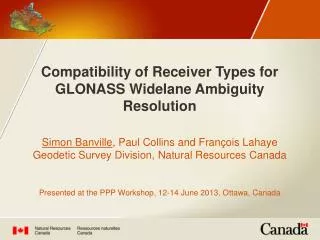
Compatibility of Receiver Types for GLONASS Widelane Ambiguity Resolution
260 likes | 364 Vues
This presentation explores the compatibility of various GLONASS receiver types in the context of widelane ambiguity resolution. It discusses the inter-frequency phase biases, their calibration versus estimation, and the characterization of inter-frequency code biases. The application to the Melbourne-Wübbena combination is highlighted, showcasing methods used for ambiguity resolution and the effects of receiver types on bias estimates. The findings indicate dependencies on receiver models, firmware versions, and antenna types, advocating for calibration to ensure consistency in geodetic observations.


Compatibility of Receiver Types for GLONASS Widelane Ambiguity Resolution
E N D
Presentation Transcript
Compatibility of Receiver Types forGLONASS Widelane Ambiguity ResolutionSimon Banville, Paul Collins and François LahayeGeodetic Survey Division, Natural Resources CanadaPresented at the PPP Workshop, 12-14 June 2013, Ottawa, Canada
Outline • GLONASS inter-frequency phase biases • Calibration vs estimation of phase biases • Characterization of GLONASS inter-frequency code biases • Application to the Melbourne-Wübbena combination • Summary and future work
Inter-frequency phase biases Between-receiver phase observation • Carrier-phase biases are only “apparent” biases: • Computing the reference ambiguity using [phase – code] can cause an apparent frequency-dependent bias due to a misalignment between phase and code observables. [Sleewaegen et al. 2012] Receiver-clock parameter Reference ambiguity DD ambiguity
Inter-frequency phase biases • Apparent carrier-phase biases: From Sleewaegen et al. (2012).
Calibration vs estimation • GLONASS inter-frequency phase biases can be calibrated [Wanninger 2012]:
Calibration vs estimation • GLONASS inter-frequency phase biases can also be estimated on the fly [Banville et al. 2013]: • A system of n observations and n unknowns can be defined. • DD ambiguities will be integers if reference satellites have adjacent frequency numbers. Reference satellites
UNBN (NovAtel) – UNBJ (Javad) baseline Calibration vs estimation Ambiguities naturally converge to integers. From Banville et al. (2013).
Inter-frequency code biases • For long-baseline ambiguity resolution (or PPP), use of the Melbourne-Wübbena combination is often made. • Need to deal with inter-frequency code biases (IFCB)… • Application of the phase-bias estimation strategy can absorb the linear component of IFCB. • Do IFCB have a linear dependency on the frequency channel number? • If so: no calibration needed! • If not: are they consistent for a given receiver type?
Inter-frequency code biases • Test network: 145 stations from EUREF on 2013-03-01
Inter-frequency code biases • Pre-analysis using ionosphere-free code observations • Based on code residuals from PPP (GPS+GLONASS). • If ionosphere-free IFCB have a linear dependency on the frequency channel number, so will the narrowlane IFCB used in the Melbourne-Wübbena combination.
Inter-frequency code biases Leica [C1/P2] (68) Trimble [C1/P2] (32) • Ionosphere-free IFCB (from PPP) Leica antennas without domes Ashtech antenna Ashtech antenna Older firmware
Inter-frequency code biases Septentrio [C1/P2] (4) NovAtel [C1/P2] (6) • Ionosphere-free IFCB (from PPP) PolarX3 PolarX4 14 hours of data missing
Inter-frequency code biases Javad Legacy [P1/P2] (7) Javad [C1/P2] (16) • Ionosphere-free IFCB (from PPP) AOAD/M_T OSOD Note: Javad Legacy receivers show a certain compatibility. Sampling was not sufficient to draw significant conclusions for other Javad models.
Inter-frequency code biases From NRCan Topcon NetG3 [P1/P2] (5+8) Topcon [C1/P2] (19) • Ionosphere-free IFCB (from PPP) Non-linear ??? “Outliers” Note: There is a certain consistency between models for Topcon receivers, although there are “outliers” and a dependency on antenna type.
Inter-frequency code biases • Summary • Most receivers show a quasi-linear dependency of the IFCB with respect to the frequency channel number. • For a given receiver make, IFCB can be affected by: • Antenna type and domes • Receiver model (and firmware version) • Residuals effects will propagate into clock/bias estimates and could create inconsistencies if not accounted for: calibration is required.
Application to Melbourne-Wübbena • Methodology: • Estimate one set of daily satellite M-W biases (1/satellite) for Leica receivers. • Estimate one set of daily satellite M-W offsets (1/satellite) per receiver type (to check for receiver compatibility). • Estimate each station M-W bias, reference ambiguity and a widelane ambiguity per arc. • Fix ALL ambiguity parameters to closest integer and look at residuals.
Application to Melbourne-Wübbena Internal consistency • Leica (68 stations) 92.8% < 0.15 cycles
Application to Melbourne-Wübbena Offset w.r.t. Leica Internal consistency • Trimble (32 stations) 90.6% < 0.15 cycles
Application to Melbourne-Wübbena Offset w.r.t. Leica Internal consistency • NovAtel (6 stations) 97.7% < 0.15 cycles
Application to Melbourne-Wübbena Offset w.r.t. Leica Internal consistency • Septentrio (4 stations) 98.9% < 0.15 cycles
Application to Melbourne-Wübbena Internal consistency • Javad (14 stations) • Notes: • Javad Legacy and Javad Delta don’t seem compatible. • Javad Legacy only (7) [P1/P2]: 91.9% < 0.15 cycles • Larger sampling needed to analyze Javad Delta. 78.7% < 0.15 cycles
Application to Melbourne-Wübbena Internal consistency • Topcon (19 stations) • Notes: • Topcon NetG3, NetG3A, EGG_D and Odyssey don’t seem compatible. • Dependency on antenna type and “outliers”. 64.6% < 0.15 cycles
Summary and future work • Application of the phase-bias estimation strategy to the (undifferenced) Melbourne-Wübbena combination: • Removes the linear trend of the narrowlane IFCB. • Residual IFCB effects are estimated as a part of the M-W satellite biases. • One set (or more) of biases is needed per receiver type (unless compatible). • Not all receiver/antenna combinations can be accommodated by this approach at this point... • The method can still allow GLONASS widelane ambiguity resolution on a rather large subset of stations.
Summary and future work • Future work • For ION GNSS 2013: • Apply M-W GLONASS biases to processing of long baselines. • What is the stability of GLONASS satellite M-W biases? • Generate ionosphere-free GLONASS satellite clocks.
References • Banville, S., P. Collins and F. Lahaye (2013). “GLONASS ambiguity resolution of mixed receiver types without external calibration,” GPS Solutions. Published online. • Sleewaegen, J.M., A. Simsky, W. de Wilde, F. Boon and T. Willems (2012). “Demystifying GLONASS inter-frequency carrier phase biases,” InsideGNSS, Vol. 7, No. 3, pp. 57-61. • Wanninger, L. (2012). “Carrier-phase inter-frequency biases of GLONASS receivers,” Journal of Geodesy, Vol. 86, No. 2, pp. 139-148.
Questions simon.banville@nrcan.gc.ca