This chapter delves into the various theories of intelligence, including Charles Spearman's g-factor and Howard Gardner's multiple intelligences. It discusses the limitations of single IQ scores in predicting life success and emphasizes the importance of personality and emotional intelligence. The chapter also highlights distinct abilities found in individuals with autism and the concept of creative intelligence. Moreover, it touches upon various intelligence tests and their evolution, explaining how standardized measures assess intelligence in diverse contexts.
01 / 53Exploring Intelligence: Multiple Theories and Measurement Approaches
1 / 17
Télécharger la présentation
Exploring Intelligence: Multiple Theories and Measurement Approaches
Une image / un lien ci-dessous est fourni (tel quel) pour télécharger la présentation
Politique de téléchargement : le contenu du site vous est fourni TEL QUEL pour votre information et votre usage personnel ; il ne peut être vendu, concédé sous licence ni partagé sur d’autres sites sans l’accord de son auteur.Le contenu vous est fourni TEL QUEL, pour votre information et votre usage personnel uniquement.Téléchargez la présentation en cliquant sur ce lien.Lors du téléchargement, si vous ne parvenez pas à télécharger une présentation, l’éditeur a peut-être supprimé le fichier de son serveur.Pendant le téléchargement, si vous ne parvenez pas à obtenir une présentation, le fichier a peut-être été supprimé par l’éditeur.
F I N
Plus de contenu associé
Transcription de la présentation
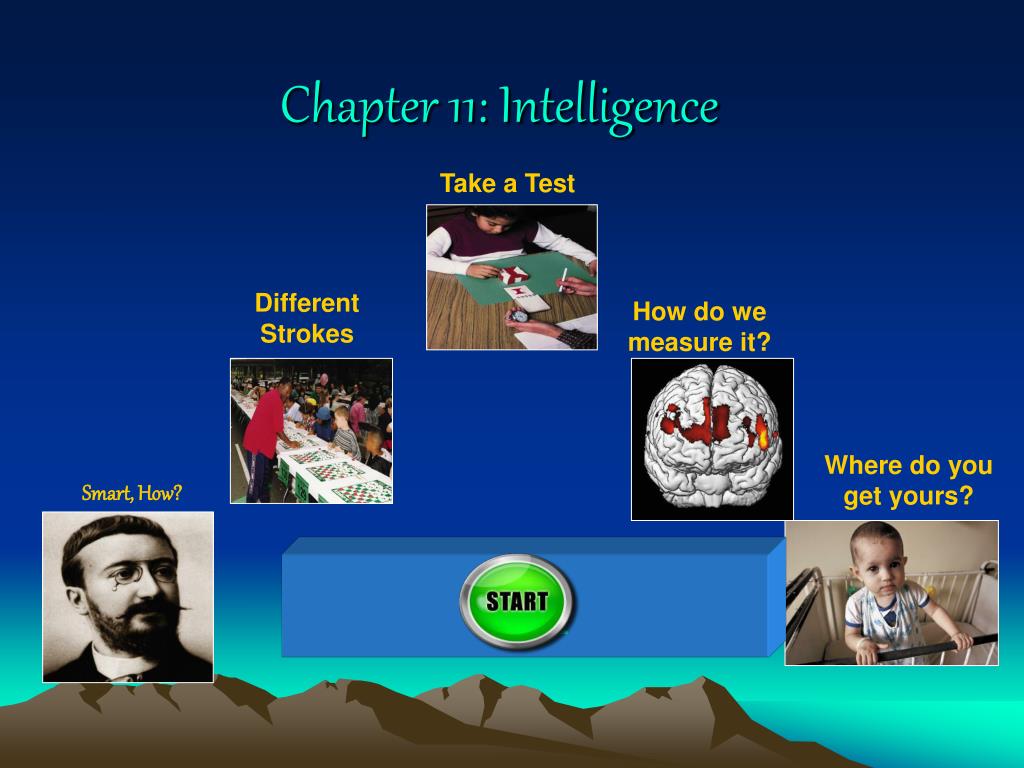
Chapter 11: Intelligence Take a Test Different Strokes How do we measure it? Where do you get yours? Smart, How? 100
1. Charles Spearman believed: • A) intelligence could not be measured by only one IQ score. • B) IQ alone can not predict success in life. • C) the g factor describes general, overall intelligence. • D) personality is more important than IQ in measuring success.
2. Howard Gardner believes that intelligence must be defined: • A) by a single factor, called g. • B) within the context of a particular culture. • C) in terms of Verbal, Performance and Full Scale IQ’s. • D) in terms of multiple factors.
3. Some people, mostly males with autism, have extremely limited abilities; yet, they have a specific ability far beyond the capabilities of the average person. They have: • A) mental retardation. • B) the g factor. • C) inherited genius. • D) savant syndrome.
8. Studies show that intelligent people differ in their brain’s ability to adapt and grow to the environment, called: • A) synaptic development. • B) neural plasticity. • C) developmental process. • D) inherited potential.
10. In considering the impact of general intelligence on success: • A) measured IQ is correlated with obtaining academic success. • B) emotional IQ is correlated with being successful in one’s career. • C) measured IQ is correlated with obtaining a good job. • D) all of the above.
11. Originally, IQ was determined by calculating: • A) the average score on Binet’s test. • B) mental age / chronological age X 100. • C) the total score on Binet’s test. • D) chronological age X mental age / 100.
12. Lewis Terman made changes to an earlier test, established new norms and published it as the first American intelligence test, called the: • A) Binet Intelligence Test. • B) Wechsler Intelligence Scales. • C) Stanford-Binet Intelligence Test. • D) Alpha-Beta Test of Intelligence.
13. Today’s IQ is different from the original in that: • A) it is no longer calculated with a formula. • B) it is based on the average performance for each age group. • C) it is no longer an “intelligence quotient”. • D) all of the above.
15. The Wechsler Scales have the important advantage over the Stanford-Binet in that the WAIS offers: • A) a more accurate measure of g. • B) several scores other than the general IQ. • C) easier administration. • D) a more reliable instrument.
21. As adopted children grow up, their intelligence: • A) varies considerably according to their environment. • B) is much more like their adoptive parents. • C) is much more like their biological parents. • D) is nothing like either their adoptive or biological parents.
22. Project Head Start’s effectiveness: • A) dissipates over time. • B) can help disadvantaged children prepare for school. • C) has long lasting benefit on emotional intelligence. • D) all of the above.
23. The finding that Asian students significantly outperform North American students in math achievement tests is because: • A) Asians are genetically superior in math. • B) Asian students spend much more time studying math. • C) American students watch too much TV. • D) American students have more important things to do.
1. Charles Spearman believed: • A) intelligence could not be measured by only one IQ score. • B) IQ alone can not predict success in life. • C) the g factor describes general, overall intelligence. • D) personality is more important than IQ in measuring success. 432
2. Howard Gardner believes that intelligence must be defined: • A) by a single factor, called g. • B) within the context of a particular culture. • C) in terms of Verbal, Performance and Full Scale IQ’s. • D) in terms of multiple factors. 433
3. Some people, mostly males with autism, have extremely limited abilities; yet, they have a specific ability far beyond the capabilities of the average person. They have: • A) mental retardation. • B) the g factor. • C) inherited genius. • D) savant syndrome. 433
8. Studies show that intelligent people differ in their brain’s ability to adapt and grow to the environment, called: • A) synaptic development. • B) neural plasticity. • C) developmental process. • D) inherited potential. 440
10. In considering the impact of general intelligence on success: • A) measured IQ is correlated with obtaining academic success. • B) emotional IQ is correlated with being successful in one’s career. • C) measured IQ is correlated with obtaining a good job. • D) all of the above. 437
11. Originally, IQ was determined by calculating: • A) the average score on Binet’s test. • B) mental age / chronological age X 100. • C) the total score on Binet’s test. • D) chronological age X mental age / 100. 444
12. Lewis Terman made changes to an earlier test, established new norms and published it as the first American intelligence test, called the: • A) Binet Intelligence Test. • B) Wechsler Intelligence Scales. • C) Stanford-Binet Intelligence Test. • D) Alpha-Beta Test of Intelligence. 443
13. Today’s IQ is different from the original in that: • A) it is no longer calculated with a formula. • B) it is based on the average performance for each age group. • C) it is no longer an “intelligence quotient”. • D) all of the above. 444
15. The Wechsler Scales have the important advantage over the Stanford-Binet in that the WAIS offers: • A) a more accurate measure of g. • B) several scores other than the general IQ. • C) easier administration. • D) a more reliable instrument. 445
16. A subject will be administered the WAIS or the WISC, depending on: • A) whether or not the subject can read. • B) the primary language of the subject. • C) the age of the subject. • D) the training of the administrator. 445
21. As adopted children grow up, their intelligence: • A) varies considerably according to their environment. • B) is much more like their adoptive parents. • C) is much more like their biological parents. • D) is nothing like either their adoptive or biological parents. 456
22. Project Head Start’s effectiveness: • A) dissipates over time. • B) can help disadvantaged children prepare for school. • C) has long lasting benefit on emotional intelligence. • D) all of the above. 458
23. The finding that Asian students significantly outperform North American students in math achievement tests is because: • A) Asians are genetically superior in math. • B) Asian students spend much more time studying math. • C) American students watch too much TV. • D) American students have more important things to do. 460
Connexion au compte
Connectez-vous pour publier votre contenu sur SlideServe.