
MATTER
E N D
Presentation Transcript
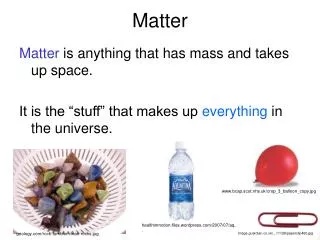
MATTER DEFINTION: ANYTHING THAT HAS • MASS TAKES UP SPACE
General properties: 1. Mass: the number of atoms and molecules
General properties 2. Volume – the amount of space it takes up
General Properties 3. Weight : the affect of gravity on mass
General properties 4. Density – compares mass to volume
General properties 5. Inertia – resists a change in its state of motion
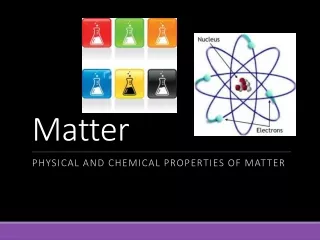
CHARACTERISTICS THAT CAN BE OBSERVED OR MEASURED PHYSICAL PROPERTIES OF MATTER
VISCOSITY • RESISTANCE TO FLOWING
CONDUCTIVITY • ABILITY TO ALLOW HEAT OR ELECTRICITY TO FLOW
MALLEABILITY • ABILITY OF A SOLID TO BE HAMMERED WITHOUT SHATTERING
HARDNESS • RESISTANCE OF A MATERIAL TO BEING SCRATCHED BY ANOTHER MATERIAL
State of Matter • Solid • Liquid • Gas • Plasma
Solubility • The ability of one substance to dissolve in another at a given temperature and pressure.
Buoyancy Able to stay immersed Or floating in a liquid
Chrystalinity • Atoms are arranged in a regular, repeating pattern.
Transparency • Allows light to pass through with little interference.
Freezing Point • The temperature at which a liquid changes to a solid.
MELTING POINT • TEMPERATURE AT WHICH A SUBSTANCE CHANGES FROM A SOLID TO A LIQUID
BOILING POINT • TEMPERATURE AT WHICH A SUBSTANCE CHANGES FROM A LIQUID TO A GAS
DENSITY • MASS/VOLUME
Luster Ability to reflect light (Shiny)
Brittleness • Shatters when hit with a hammer.
Ductility • The ability of a substance to be pulled into a wire.
Physical properties are used for • To choose the right material for the right job • To separate mixtures Filtration Distillation