CAVITY LOCK ELECTRONICS
This project presents a comprehensive electronics design for achieving and maintaining cavity resonance in laser systems. Key features include slow and fast laser frequency scanning, error compensation, and an onboard micro-controller compatible with Stanford Research's SIM900 crate. The system employs the Pound-Drever-Hall locking scheme for precise cavity length stabilization. Advanced feedback control loops and modulation capabilities enhance performance through efficient error signal processing. Presently, the PCB has been assembled and bench testing is completed, with in-system calibration underway.


CAVITY LOCK ELECTRONICS
E N D
Presentation Transcript
CAVITY LOCK ELECTRONICS Dan Sexton, Sirish Nanda, and Abdurahim Rakhman
Design Goals • Lock-In on Cavity Resonance • Slow and Fast Laser Frequency Scan • Slow and Fast Error Compensation • Incorporate on board micro-controller • Compatible with Stanford Research SIM900 Crate
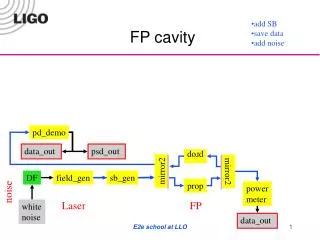
Beam Splitter Tunable Laser Cavity Oscillator PID-Regulator Photo detector Phase Shifter 0 Error signal Mixer Low Pass Filter System Schematic • Keep the cavity resonate forever • It is very hard to stabilize the cavity length in nm level Pound-Drever-Hall Locking Scheme • Detect phase of the resonance from reflected light • Feedback to tunable element to stay “locked” to resonance
Electronics Overview • Slow and Fast Laser Frequency Scan • Search for Signal of Interest • Slow Scan Rate – 0.01 Hz – 1Hz • Fast Scan Rate – 3 Hz – 30Hz • External Modulation • 10-30 mV @ 1MHz Signal • Error Input and Output • Polarity Selection (+/-)
Electronics Overview (cont’d) • Slow and Fast Error Feedback • Integration and Gain Control Loops (PI) • Gain Range – x0.1 – x1 • Integration Time – 1mS – 10mS • Optional Features • Trigger Monitor or Input • Threshold Monitor or Input
Electronics Overview (cont’d) • Analog Devices ADuC-70xx series Micro-Controller • 32-Bit 44MHz ARM processor • 8 ADC CHs and 4 DAC CHs • Drop in module in two different packages • Option A – OLIMEX Evaluation Card ADuC-7026 (3” x 3”) • Option B – OLIMEX DIP Socket ADuC-7020 (1” x 2”)
Electronics Overview (cont’d) • Stanford Research SIM900 Crate • Off the shelf “Modular System” • GPIB and RS-232 interface • Regulated Power Supply
Current Status • PCB and enclosure in hand and assembled • Bench Testing completed • In System Calibration Beginning