Implement CERES regional lapse rates to improve low cloud height
370 likes | 558 Vues
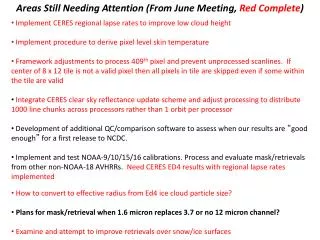
Areas Still Needing Attention (From June Meeting, Red Complete ). Implement CERES regional lapse rates to improve low cloud height Implement procedure to derive pixel level skin temperature


Implement CERES regional lapse rates to improve low cloud height
E N D
Presentation Transcript
Areas Still Needing Attention (From June Meeting, Red Complete) • Implement CERES regional lapse rates to improve low cloud height • Implement procedure to derive pixel level skin temperature • Framework adjustments to process 409th pixel and prevent unprocessed scanlines. If center of 8 x 12 tile is not a valid pixel then all pixels in tile are skipped even if some within the tile are valid • Integrate CERES clear sky reflectance update scheme and adjust processing to distribute 1000 line chunks across processors rather than 1 orbit per processor • Development of additional QC/comparison software to assess when our results are “good enough” for a first release to NCDC. • Implement and test NOAA-9/10/15/16 calibrations. Process and evaluate mask/retrievals from other non-NOAA-18 AVHRRs. Need CERES ED4 results with regional lapse rates implemented • How to convert to effective radius from Ed4 ice cloud particle size? • Plans for mask/retrieval when 1.6 micron replaces 3.7 or no 12 micron channel? • Examine and attempt to improve retrievals over snow/ice surfaces
Other Accomplishments/Needs From Summer 2013 • Found that Yost thick cloud top height correction was not being called. P. Heck corrected retrieval code to enable this correction • Pixel level skin temperature retrieval methodology has been revamped to provide improved results • Other minor get_cloud edits per discussions between PM and PH (singlescat definition, use of “dif” parameter) • Found cases where stratocu cloud edges are being identified as ice phase, set up PH with AVHRR framework for debugging • Developed software for analyzing VZA dependence of AVHRR observations and retrieved parameters • Need to compute 24-hour mean surface temperature over land to use in regional lapse-rate code
AVHRR PROCESSING STEPS AND TIMING 2 DAYS OF ORBITS (28 ORBIT FILES) 125 MAX SIMULTANEOUS AMI JOBS 1) AVHRR Level 1B to NetCDF Conversion: Navigation/Parallax Correction, and Noise Filtering (if necessary, NOAA-6 to -14): 1 min 40 sec 2) Break orbits into 1000 scanline segments (Typical orbit: ~13000 scanlines), process with cloud retrieval code, write out 1000-line NetCDFs with 31 parameters: 14 min 20 sec 3) Merge 1000-line NetCDFs into 1 file for the entire orbit, add all necessary metadata such as max/min time max/min lat/lon: 1 min 4) Read in 2 days of full orbit NetCDFs, use adaptation of CERES Ed4 clear sky 0.65 um overhead albedo dynamic updating algorithm with MODIS maps as first-guess, generate 10-min resolution snow-free and snow-covered overhead albedo maps: 3 min 5 sec Total time: 20 min 5 sec * 15.5 2-day periods = ~312 mins = 5.2 hrs/month 1 Year = 2.6 days Total time without updating: 16 min * 15.5 2-day periods = 248 mins = 4.13 hrs/month
Dynamic map updated over 15 2-day periods, reflects conditions present on October 30
ICE/SNOW MAP COMPARISONS Western U.S.
ICE/SNOW MAP COMPARISONS Antartica CERES SNOW/ICE MAP MERRA SNOW/ICE MAP
AVHRR Pixel Level Skin Temperature Ben Scarino
October 2008 Pixel Skin Temperature: Original Method Take pixel from TOA down to surface using corr-k to “surface-leaving” IR temperature. Convert to skin temperature via Jin ocean emissivity: f(vza, wind speed (constant: 5 m/s))
October 2008 Pixel Skin Temperature: Ratio Method, 3x3 Cloud Filter MERRA skin temperature is brought to TOA via corr-k, where it is compared with observed TOA temperature, which has been gridded to the same resolution as MERRA. A correction for the surface, based on the TOA difference, is determined. That correction is applied to the MERRA skin temperature yielding a true skin temperature that is on the same resolution as MERRA. The ratio of TOA radiance to surface radiance is applied to pixel-level TOA radiance (for all pixels that fall within that grid box), thus yielding a pixel-level surface radiance. That pixel-level surface radiance is then converted to a pixel-level skin temperature. Filter out pixels with any adjacent cloud pixels
October 2008 Pixel Skin Temperature: Ratio Method, No Cloud Filter No adjacent cloud pixel filtering