Explore Ancient Egypt: Three Kingdoms and Civilizations
Delve into the rich history of Ancient Egypt - from the Old Kingdom to the New Kingdom. Discover the social structure, achievements, and decline of each era. Uncover the mysteries of Egyptian religion, writing, and afterlife beliefs.

Explore Ancient Egypt: Three Kingdoms and Civilizations
E N D
Presentation Transcript
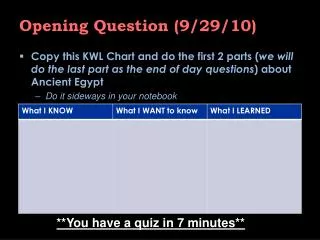
Opening Question (9/29/10) • Copy this KWL Chart and do the first 2 parts (we will do the last part as the end of day questions) about Ancient Egypt • Do it sideways in your notebook **You have a quiz in 7 minutes**
Egypt Three Kingdoms on the Nile
Contents • Geography • Old Kingdom • Middle Kingdom • New Kingdom
Early Egypt • Developed after Sumer • Contact by sea • Imitated Sumerian arch • Soon developed own culture • Social Classes form • Rigid Class System • Upper Class includes royal family, nobility, priests and government officials • Lower classes included peasants, laborers and slaves
Geography • Nile River • floods annually, depositing silt • flows south to north • longest river in the world • Nile Delta • delta = triangular area of marshland formed by silt deposits
The Nile cont… • Slow flowing • Enclosed by desert and rock valleys • Delta opens into Mediterranean Sea • “Gift of the Nile” • Seen as their lifeline
First (Old) Kingdom Develops • Menes – 3100 BC • Unites Upper and Lower Egypt • First Pharaoh (emperor) • Establishes first dynasty (ruling family)
Three Kingdoms - Time • Old Kingdom • 2700 – 2200 BCE • Middle Kingdom • 2050 – 1800 BCE • New Kingdom • 1550 – 1100 BCE
Old – Government • strong central authority/government • pharaoh = ruler • believed to be a god • had absolute power • vizier = chief minister • supervised day-to-day business • head of large bureaucracy
Old – Achievements • Pyramids at Giza • tombs for eternity • pharaohs started building when they took the throne • Old Kingdom also called “Pyramid Age”
Old – Decline • power struggles • b/w pharaohs and nobility • crop failures • Hurt growth • cost of the pyramids • Drained Egyptian economy
Middle – Government • Turbulent period • Irregular flooding • corruption and rebellions are common • traded more with outside people from Middle East
Middle – Achievements • Large drainage project creates new arable land • Army occupies Nubia to the south • Traders have more contact w/ other civilizations
Middle – Decline • invaded by Hyksos • adopt chariots from Hyksos • Hyksos adopt Egyptian customs, beliefs, names
New – Government • New leaders drive out Hyksos • Strong pharaohs • Hatshepsut = woman pharaoh who encouraged trade • Amenhotep = tried to change Egypt to a monotheistic society • Ramses II = most powerful, “Ramses the Great”, last great pharaoh to rule Egypt
New – Achievements • Large empire reaches Euphrates River • More contact w/ other civilizations • First known peace treaty w/ Hittites who were located in Mesopotamia
New – Decline • Power declines after Ramses II • Invaders conquer Nile region • Assyrians and Persians from the Middle East and Nubians from the south • By 300 BC Egypt will be ruled by other Empires for a long time
Overall Achievements in Egypt • Calendar • 365 days, 12 months with 30 days each, moth is divided into 3 weeks that are each 10 days • Medicine • Treatments were often rational and appropriate (not just magic, spells and hymns for cures) • Priests and magicians still used though • Procedures for prognosis, diagnosis and simple surgeries
Egyptian Writing • Writing • Pictograms evolved into hieroglyphics • Developed Papyrus to write on • Dried Leaf used – like paper but not as easy to make • Only Scribes could read and write • Rosetta Stone (Made in 196 BC) • Tablet found by Napoleon’s soldiers in 1799 and was translated in 1822 • Had Greek, Demotic, and Hieroglyphics • Greek first translated then Demotic then Hieroglyphics
Religion • Guided every part of life • Polytheistic • Ra / Amon-Ra = sun god • Horus = sky god Horus carrying Ra
Religion continued • Osiris – God of the Nile, rebirth, underworld • Isis – Goddess of the dead, wife of Osiris
http://www.youtube.com/watch?v=K5Bwkb_AJi0&feature=related • Afterlife • Mummification and burial
Four sons of Horus Qebehsenuef Intestines Duamutef Stomach Imsety Liver Hapi Lungs Canopic jars Brain hook
Opening of the mouth ceremony Okay, that’s it, have a good afterlife!
Anubis Hoth Osiris Amut Weighing of the heart