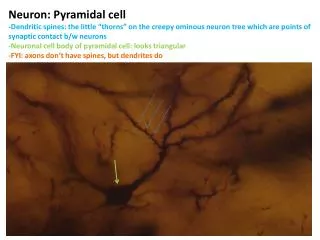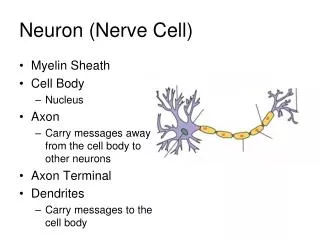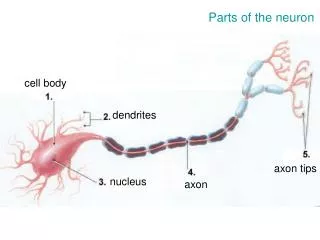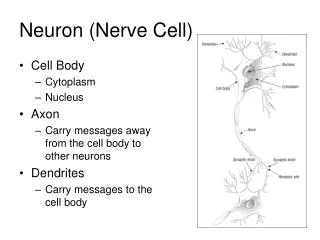
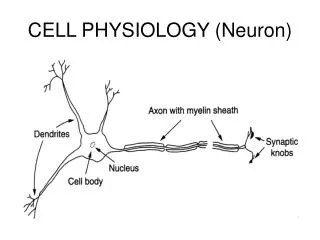
CELL PHYSIOLOGY (Neuron)
CELL PHYSIOLOGY (Neuron). ANATOMY OF A SYNAPSE (Synaptic Knob and Motor End Plate). CELL MEMBRANE. ACTION POTENTIAL. CENTRAL NERVOUS SYSTEM. Sensorimotor cortex Basal ganglia Cerebellum Brain stem Spinal cord Pyramidal tract Extrapyramidal tract. TYPES OF NEURONS.

CELL PHYSIOLOGY (Neuron)
E N D
Presentation Transcript
CELL PHYSIOLOGY (Neuron) IE 552
ANATOMY OF A SYNAPSE(Synaptic Knob and Motor End Plate) IE 552
CELL MEMBRANE IE 552
ACTION POTENTIAL IE 552
CENTRAL NERVOUS SYSTEM • Sensorimotor cortex • Basal ganglia • Cerebellum • Brain stem • Spinal cord • Pyramidal tract • Extrapyramidal tract IE 552
TYPES OF NEURONS IE 552
SARCOPLASMIC RETICULUM IE 552
EXCITATION-CONTRACTION SEQUENCE #1 • AP moves down neuron • Release of ACH across synapse, receptor • Motor end plate P → muscle action P • SR releases Ca++ into filaments • Inhibits troponin • ATP split: ATP∙M → ADP∙Pi∙M • A M bonding: ADP∙Pi∙M → A-M∙ADP∙Pi IE 552
EXCITATION-CONTRACTION SEQUENCE #2 • ATP split completely leaving bridge A-M∙ADP∙Pi → A-M + ADP + Pi • Break AM bond with fresh ATP A-M + ATP → A + M∙ATP • Myosin advances to next actin, repeat • Relaxation, Ca++ released from troponin • Ca++ back into SR using ATP IE 552
MOTOR UNIT RECRUITMENT IE 552
MOTOR UNIT CHARACTERISTICS IE 552
TWITCH AND TETANUS IE 552
VELOCITY-TENSION RELATIONSHIP • Concentric • Eccentric • Isometric • ↓ bonding • Damping • Peak power = ⅓ vmax IE 552
TYPES OF CONTRACTIONS • Static (Isometric) = constant muscle length • Dynamic = muscle length changes • Concentric = muscle shortens • Eccentric = muscle lengthens • Isotonic = constant external force • Isokinetic = constant velocity • Isoinertial = constant acceleration IE 552
QUICK RELEASE EXPERIMENTS(#2 – Series Elastic Component) IE 552
HILL’S 4-ELEMENT MODEL IE 552
ENDURANCE CURVES • Voluntary hold • Static contraction • Occlusion of blood flow • Rapid fatigue • T = 1236 - 72.5 (%MVC-15)0.618 IE 552