Download
1 / 23
230 likes | 335 Vues
Explore the elements of consideration when designing rational agents and the categorization of environments in artificial intelligence, focusing on PEAS, performance measures, actuators, sensors, and environment types. Learn about state space graphs and problem-solving agents in the context of search algorithms. Delve into the attributes that define environments and understand how they impact agent behavior and decision-making processes.

E N D
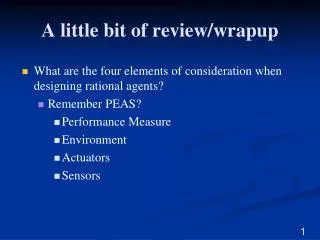
A little bit of review/wrapup • What are the four elements of consideration when designing rational agents? • Remember PEAS? • Performance Measure • Environment • Actuators • Sensors
PEAS - Internet news gathering agent Scans Internet news sources to pick interesting items for its customers • Performance measure? • Environment? • Actuators? • Sensors?
Environment Types • We often describe the environment based on six attributes. • Fully/partially observable • Deterministic/stochastic • Episodic/sequential • Static/dynamic • Discrete/continuous • Single agent/multiagent
Environment Types • Categorization of environment tasks: • Fully/partially observableextent to which an agent’s sensors give it access to the complete state of the environment • Deterministic/stochasticextent to which the next state of the environment is determined by the current state and the current action
Environment Types • Categorization of environment tasks: • Episodic/sequentialextent to which the agent’s experience is divided into atomic episodes • Static/dynamicextent to which the environment can change while the agent is deliberating
Environment Types • Categorization of environment tasks: • Discrete/continuousextent to which state of the environment, time, percepts and actions of the agent are expressed as a set of discrete values • Single agent/multiagent
Artificial Intelligence in the 21st CenturyS. Lucci / D. Kopec • Chapter 2:Uninformed Search
Contents • 2.0Search in Intelligent Systems • 2.1 State Space Graphs • 2.2 Generate and Test Paradigm • 2.3 Blind Search Algorithms • 2.4 Implementing and Comparing Blind Search Algorithms • Summary
Problem Solving by Searching • “Problem solving agents decide what to do by finding sequences of actions that lead to desirable states.” • Search is a natural part of people’s lives
Remember this Problem? • Three missionaries and three cannibals • Want to cross a river using one canoe. • Canoe can hold up to two people. • Can never be more cannibals than missionaries on either side of the river. • Aim: To get all safely across the river without any missionaries being eaten. • Did you solve it? How????
One Solution • Send over 2 Cannibals • Send one Cannibal back • Send over 2 Cannibals • Send one Cannibal back • Send over 2 Missionaries • Send one Cannibal and one Missionary back • Send over 2 Missionaries • Send one Cannibal back • Send over 2 cannibals • Send one cannibal back • Send over 2 cannibals
How About Another Problem? • Example: Traveling in Romania • On holiday in Romania; currently in Arad.Flight leaves tomorrow from Bucharest
How About Another Problem? • Example: Traveling in Romania • On holiday in Romania; currently in Arad.Flight leaves tomorrow from BucharestFormulate goal: be in BucharestFormulate problem: states: various cities actions: drive between citiesFind solution: sequence of cities, e.g., Arad, Sibiu, Fagaras, Bucharest
Observable?? Deterministic?? Episodic?? Static?? Discrete?? Agents?? Yes Yes Either Yes Yes Either Appropriate environment for Searching Agents
2.1 State Space Graphs • A mathematical structure that helps to formalize the search process • Possible alternative paths leading to a solution can be explored and analyzed • A solution to a problem will correspond to a path through a state space graph