Enhancing Migratory Species Conservation through WHMSI Capacity Building Initiatives
This session discusses the findings from WHMSI 2 on capacity building needs for conserving migratory species. Insights into the Year 1 subregional training workshops will be provided, covering RFP distribution, proposal submissions, and review outcomes. Furthermore, we will outline priority audiences and themes for Years 2 and 3 training, and engage in planning subregional action plans within three working groups focused on Mesoamerica, the Caribbean, and South America. The aim is to implement effective capacity building strategies for improved conservation management in the Americas.

Enhancing Migratory Species Conservation through WHMSI Capacity Building Initiatives
E N D
Presentation Transcript
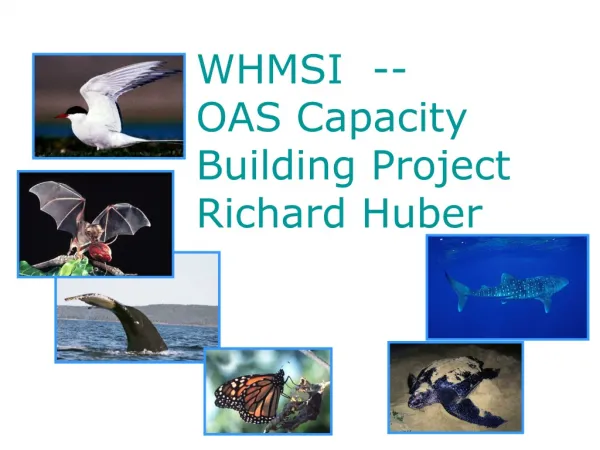
WHMSI -- OAS Capacity Building Project Richard Huber
WHMSI Capacity Building 3:30pm-4pm: Review of capacity building needs for the conservation of migratory species based on results from WHMSI 2 RFP for implementation of Year 1 subregional training workshops: information on how RFP was distributed; proposals submitted; review process; review outcomes 5:30pm-6pm: Discussion of Years 2 and 3 priority audiences and themes for training
WHMSI Capacity Building • 4pm-5:30pm: Planning for subregional action plans to implement capacity building strategies (3 working groups) Bar Social I, II and Salon Itaipu • 3 working groups: 1) Mesoamerica; 2) Caribbean; 3) South America. ISC members will serve as moderators for each session. • Each WG will be charged with refining the content and duration of each training workshop and developing a training agenda, adding partners, based on available funds.
CAPACITYBUILDING IMPLEMENTATION PLAN FOR IMPROVED MIGRATORY SPECIES CONSERVATION AND MANAGEMENT IN THE AMERICAS HEMISPHERE -- IDENTIFIED AT THE WHMSI CONFERENCE IN SAN JOSE, COSTA RICA, 2006 1) Monitoring & Evaluation 2) Administration, including Fundraising/ Financial Mechanisms, Organization Administration/ Management, and Project Development/ Management 3) Social and Economics Issues, including Law, Policy Understanding and Compliance / Conflict Resolution / Economic Incentives (for Legislators-Political Officials); Sustainable Development and Ecotourism (for Community Leaders) Audiences: Community Leaders, Legislators-Political Officials 4) Environmental Education and Outreach 5) Sustainable Resource Use, including Sustainable Harvest, Sustainable Collection and Best Practices
Definition of Audiences: Park PersonnelProtected Area Managers Technical Conservation PersonnelUpper Level Students Community Leaders Legislators-Political Officials Teachers
Visible changes in Iguazú National ParkSouth America • 1973: Forest cover is extensive throughout the region • 2003: Extensive deforestation in Paraguay
Sustainable Resource Use, including Sustainable Harvest, Sustainable Collection and Best Practices
Conversion of forests to farmlands in Santa Cruz, Bolivia • 1975: Forested landscape • 2003: Large corporate agricultural fields transform the landscape
Shrimp farms replacing mangroves in Gulf of Fonseca, Honduras 1987-1999: shrimp farms and ponds have mushroomed, carpeting the landscape around the Gulf of Fonseca, Honduras, in blocks of blue and black shapes
Changes in Ecuador’s largest sea port: Gulf of Guayaquil, Ecuador Ecuador’s primary city and largest sea port 1985-2000: Loss of mangrove and growth of aquaculture can be seen
Mexico’s largest natural lake – Lake Chapala, Mexico • 1983: Level of the lake has declines; noticeable decreases in wetlands • 2001: Alteration in the contours of the shoreline is clearly visible
Social and Economics Issues, including Law, Policy Understanding and Compliance / Conflict Resolution / Economic Incentives (for Legislators-Political Officials); Sustainable Development and Ecotourism (for Community Leaders)
Urban encroachment on Florida’s Everglades, United States • 1973: Rapid urban expansion has converted farmlands to cityscapes • 2002: Existence of vast wetlands “Everglades” threatened by urban encroachment
26% Year 2000 42% 45%
Conservation with payment for service Payment between $5-50/ton carbon to $20-40/hec/yr to 1 cent/ cubic meter of water Sediment & drought costs to downstream populations The logic of Payments for Environmental Services (PES) Conservation Deforestation, fire, and use for pasture Benefits to land users • Voluntary Participation – Private Partnership