User Datagram Protocol (UDP)
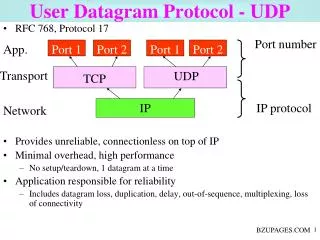
The User Datagram Protocol (UDP) is a connectionless protocol utilized primarily for applications that require fast data transmission, such as streaming audio, video, and network monitoring. Unlike TCP, UDP does not guarantee reliability, sequencing, or acknowledgment of packets. It operates using source and destination ports, establishing a virtual circuit between communicating processes on different devices. This protocol includes frame length and a 16-bit checksum to ensure data integrity, although no reliability checks are performed.

User Datagram Protocol (UDP)
E N D
Presentation Transcript
UDP • Connectionless services • No reliability checks (sequencing/acks) • Some apps • Network monitoring • DNS name resolution • Streaming audio & video
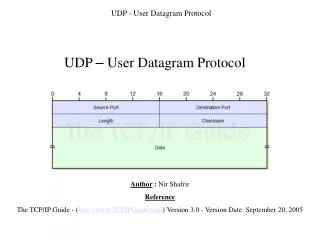
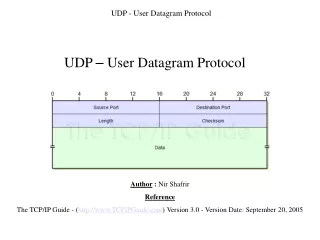
Frame format • Source Port/Destination Port: A port (socket/session) Virtual circuit between two communicating processes on two different computers or devices • The source port is the port on the sending device. • The destination port is a TCPport on a receiving device that corresponds with the source port on the sending device • Length: contains information about the length of the frame • Checksum: The checksum is a 16-bit cyclic redundancy check (CRC) that is computed by adding the length of all header fields plus the length of the data payload field (the sum of all fields in the TCP segment). • Placed in the frame by the sending station. • The recipient also calculates the checksum and compares its calculation with the value in the checksum field.