Enhancing Student Collaboration in Large Lecture Settings
180 likes | 294 Vues
This paper explores the importance of collaboration in educational settings, highlighting its role in teaching valuable skills such as self-empowerment and effective communication. It examines the challenges faced in large lectures, including student hesitation to ask questions and limited lecturer attention. Proposed solutions like SLE Notes and Question Markers aim to facilitate interaction by allowing students to anonymously ask questions and engage in discussions with peers and teaching assistants. The integration of computer-aided collaboration tools is also discussed for improving the overall learning experience.


Enhancing Student Collaboration in Large Lecture Settings
E N D
Presentation Transcript
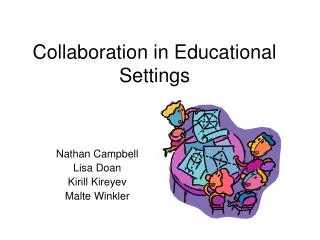
Collaboration in Educational Settings Nathan Campbell Lisa Doan Kirill Kireyev Malte Winkler
Why Collaboration? • Why Collaboration? • Teaches valuable “people” skills • Self-empowerment, responsibility, self-expression • “When you teach, you learn” • Synergy of ideas, “symmetry of ignorance” • Cognitive Dissonance Theory – resolving disagreements • Why Computer-aided Collaboration? • Helps mediate opinions (everyone is heard) • Easy to organize/visualize information • Distributed • Space / Time / People • Fun
People: Gerhard Fischer / Hal Eden (Swiki) Sebastian De La Chica (UI design) Michael Main (WebCT) Carl Wieman (Clickers) Amer Diwan Technologies: WebCT EDC FEEL (DLC ’04) Swiki Moodle Clickers Interviews & Observations
Interviews & Observations • Issues • Structured vs. unstructured • Whiteboard vs. message board • In class vs. online discussions • Generalizations • “Beaten Path” • “Cycle of Abandonment”
Design Questions • Balance online vs. face-to-face • How to integrate? • Structured (WebCT) vs Unstructured (wiki) • Freedom may be messy • General vs. specific • Mediation? • Support flexibility, evolution • Users will use in different ways
Lessons Learned from IR • Technological artifacts must be accompanied by understanding and willingness to change underlying social practices • Collaboration requires proper environment • Open-ended projects • Shared goals • Non-competitive environment • Collaborative skills need to be taught
Project Enhancing Collaboration Among Students In Large Lecture Settings
Large Lectures: Challenges • Students often have questions, but hesitate to ask • Don’t want to interrupt lecture • Shy / self-conscious • Lecturer’s attention is limited • Difficult to gauge level of student understanding, interest • Difficult to remember discourse, reasoning, opinions
Large Lectures: Opportunities • Peers represent large body of knowledge and opinions • Improve deliberation process • TAs available to answer questions • As long as not intrusive to the lecture • Clickers work well, but would be nice to: • Add justification • Persist answers (in context) for later review • Student want to ask questions • Gain confidence to know they’re not alone
Notes and Question Markers
As the Question Marks Increase the Class Confusion Histogram gives the students, TAs, and the professor a class status
Students have the ability to ask questions that get sent out to all students and TAs that they can discuss and look at the answer provided by each other or the TA. They also have the ability of increase the questions need to be answered
We also have “clicker” capability, but require justifications for every answer.
We also have “clicker” capability, but require justifications for every answer. Random Justifications are displayed. The students are able to discuss the questions with each other by simply clicking the discuss button