More on Dynamic Memory Allocation
This lecture note outlines the fundamental concepts of dynamic memory allocation and linked lists in C++. It highlights the importance of managing memory effectively, emphasizing how dynamically allocated memory resides on the heap, requires pointers for access, and necessitates proper deallocation to prevent memory leaks. The note also covers linked lists, describing their structure and usage, including how to add items dynamically and ensure safe memory management. Key concepts such as dangling pointers, memory leaks, and memory efficiency are also discussed, providing a comprehensive resource for students.


More on Dynamic Memory Allocation
E N D
Presentation Transcript
More on Dynamic Memory Allocation Seokhee Jeon Department of Computer Engineering Kyung Hee University Illustrations, examples, and text in the lecture note courtesy of Prof. David Bernstein, https://users.cs.jmu.edu/bernstdh/web/common/lectures/slides_cpp_dynamic-memory.php
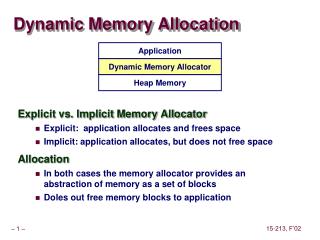
Reminders • Dynamically allocated memory is kept on the memory heap • Dynamically allocated memory can't have a "name" it must be referred by pointers • Declarations are used to statically allocate memory, the new operator is used to dynamically allocate memory
Returning Memory to the Heap • How Big is the Heap? • It can only contain as much physical memory as you have installed or as much virtual memory as your operating system can make available (if it supports virtual memory) • Running Out of Memory: • Most applications request memory from the heap when they are running • It is possible to run out of memory (you may even have gotten a message like "Running Low On Virtual Memory") • So, it is important to return memory to the heap when you no longer need it
Returning Memory to the Heap • Dangling Pointers: • The delete operator does not delete the pointer, it takes the memory being pointed to and returns it to the heap • It does not even change the contents of the pointer • Since the memory being pointed to is no longer available (and may even be given to another application), such a pointer is said to be dangling
Returning Memory to the Heap • Remember: • Return memory to the heap before undangling the pointer • What's Wrong with the Following: • ptr = NULL; • delete ptr;
Returning Memory to the Heap • What About Arrays? • You want to return all of the memory to the heap • So, a different form of the delete operator is needed • Also, the memory allocator must keep track of the size of the array
Memory Leak • Memory leaks when it is allocated from the heap using the new operator but not returned to the heap using the delete operator
Linked Lists in C and C++ CS-2303System Programming Concepts (Slides include materials from The C Programming Language, 2nd edition, by Kernighan and Ritchie and from C: How to Program, 5th and 6th editions, by Deitel and Deitel)
Note: elements are usually thesame type (but not always). Definitions • Linked List • A data structure in which each element is dynamically allocated and in which elements point to each other to define a linear relationship • Singly- or doubly-linked • Stack, queue, circular list
Note: payload may bemultiple members. payload payload payload payload next next next next Linked List struct listItem {type payload;struct listItem *next; };
Linked List (continued) • Items of list are usually same type • Generally obtained from new operator • Each item points to next item • Last item points to null • Need “head” to point to first item! • “Payload” of item may be almost anything • A single member or multiple members • Any type of object whose size is known at compile time • Including struct, union, char* or other pointers • Also arrays of fixed size at compile time (see p. 214)
Usage of Linked Lists • Not massive amounts of data • Linear search is okay • Sorting not necessary • or sometimes not possible • Need to add and delete data “on the fly” • Even from middle of list • Items often need to be added to or deleted from the “ends”
payload payload payload payload next next next next Linked List (continued) struct listItem {type payload;struct listItem *next; }; struct listItem *head;
payload payload payload payload payload next next next next next Adding an Item to a List struct listItem *p, *q; • Add an item pointed to by qafter item pointed to by p • Neither p nor q is NULL
payload payload payload payload payload next next next next next Adding an Item to a List listItem *addAfter(listItem *p, listItem *q){q -> next = p -> next;p -> next = q;return p; }
payload payload payload payload payload next next next next next Adding an Item to a List listItem *addAfter(listItem *p, listItem *q){q -> next = p -> next;p -> next = q;return p; }
payload payload payload payload payload next next next next next Adding an Item to a List Question: What to do if we cannotguarantee that p and q are non-NULL? listItem *addAfter(listItem *p, listItem *q){q -> next = p -> next;p -> next = q;return p; }
Note test for non-null p and q payload payload payload payload payload next next next next next Adding an Item to a List (continued) listItem *addAfter(listItem *p, listItem *q){if (p && q) { q -> next = p -> next; p -> next = q;}return p; }
payload payload payload payload payload next next next next next What about Adding an Itembefore another Item? struct listItem *p; • Add an item before item pointed to by p (p != NULL)
What about Adding an Itembefore another Item? • Answer:– • Need to search list from beginning to find previous item • Add new item after previous item • This is needed in PA#3 • Insert item after earlier event times and before later ones • Need to search the list
payload payload payload payload prev prev prev prev next next next next In-class exercise:– how to add a new item q after a list item p Doubly-Linked List struct listItem {type payload;listItem *prev;listItem *next; }; struct listItem *head, *tail;
Other Kinds of List Structures • Queue — FIFO (First In, First Out) • Items added at end • Items removed from beginning • Stack — LIFO (Last In, First Out) • Items added at beginning, removed from beginning • Circular list • Last item points to first item • Head may point to first or last item • Items added to end, removed from beginning
payload payload payload payload next next next next Optional:– struct listItem *head; Circular List struct listItem *tail; listItem *addAfter (listItem *p, listItem *tail){if (p && tail) { p -> next = tail -> next; tail = p;} else if (p) { tail p -> next = p;} return tail; }