
Mutations
E N D
Presentation Transcript
What Are Mutations? • Changes in the nucleotide sequence of DNA • May occur in somatic cells (aren’t passed to offspring) • May occur in gametes (eggs & sperm) and be passed to offspring
Are Mutations Helpful or Harmful? • Some mutations may improve an organism’s survival (beneficial)
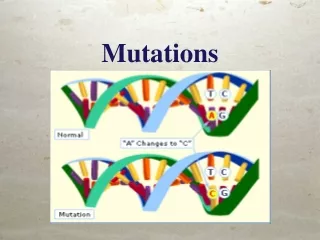
Gene Mutations • Change in the nucleotide sequence of a gene • May only involve a single nucleotide • May be due to copying errors, chemicals, viruses, etc.
Types of Gene Mutations • Include: • Point Mutations • Substitutions • Insertions • Deletions • Frameshift
Point Mutation • Change of a single nucleotide • Includes the deletion, insertion, or substitution of ONE nucleotide in a gene
Point Mutation • Original: THE FAT CAT ATE THE RAT • Mutation: • Substitution - • Insertion - • Deletion -
Frameshift Mutation • Inserting or deleting one or more nucleotides – a specific type of point mutation that can change the created protein. • Changes the “reading frame” like changing a sentence • Proteins built incorrectly
Frameshift Mutation • Original: THE FAT CAT ATE THE RAT • Mutation: • Frameshift -
Chromosome Mutations • May Involve: • Changing the structure of the chromosome of a chromosome • loss or gain of part of the chromosome of part of a chromosome
Chromosome Mutations • Several types exist: • Deletion • Inversion • Duplication
Deletion • Due to breakage • A piece of a chromosome is lost
Inversion • Chromosome segment breaks off • Segment flips around backwards • Segment reattaches
Duplication • Occurs when a gene sequence is repeated
Normal Male 2n = 46
Normal Female 2n = 46
Male, Trisomy 21 (Down’s) 2n = 47
Female Down’s Syndrome 2n = 47
Klinefelter’s Syndrome 2n = 47
Turner’s Syndrome 2n = 45