Download
1 / 10
100 likes | 206 Vues
This educational overview explores the muscular system, focusing on the three muscle types: skeletal, cardiac, and smooth muscle tissue. Muscles are essential organs formed of muscular and connective tissues that facilitate motion by contracting when they attach to bones. The structure of muscle fibers, including sarcomeres—the basic contractile units composed of actin and myosin—illustrates how contraction occurs. We will also examine the organization of muscle fibers into myofibrils, fiber bundles, and the roles of various connective tissues. Join us as we delve into muscle function for movement, involuntary processes, and more.

E N D
Unit 1:Muscles Week 1 Click images for hyperlinks!
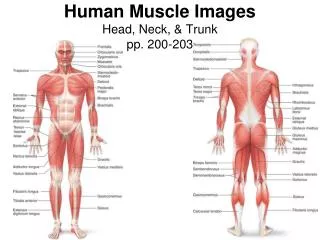
What is a muscle? • Muscles are organs made of muscular and connective tissues, which make up the Muscular System • They attach to bones and other muscles so that when they contract, they produce motion • There are three different types of muscle: • Skeletal • Cardiac • Smooth
Muscle Tissue • Muscle tissue: Collection of muscle cells which contain sarcomeres • Sarcomere: a single contractile unit made of primarily actin, myosin, and titin
Sarcomere • M-line • Only myosin • Doesn’t move • Z-disk • Perimeter of sarcomere • Moves toward M-line with contraction • I-band • Actin + titin • Spans width of titin • Shrinks with contraction • A-band • Actin + myosin • Spans width of myosin • H-zone • Only myosin • Gets smaller with contraction Myosin Actin
Sarcomere Proteins • Actin • G-actin: Globular individual pearl-like actin molecules • F-actin: G-actin pearls assemble into a Filament of actin • Myosin pulls actin inward • Contains head and tail units • Myosin head binds to actin, pulls it inward to contract • Titin pushes z-discs outward • Elastic, holds myosin in place and helps re-extend sarcomere upon relaxation
Video- Sarcomere Contraction Click video to watch
Arrangement of Fibers • Many sarcomeres together make up a myofibril • Many myofibrils make up a muscle fiber (cell) • Coated by endomysium • Many fibers make up a fiber bundle • Coated by perimysium • Many bundles make up the entire muscle • Coated by epimysium
Types of Muscle • Smooth *Found in organs (GI, vessels) for constriction -Involuntary -Non-striated -Mononucleate -Parallel fibers • Cardiac *Only in the heart for moving blood -Involuntary -Striated -Mononucleate -Branched Fibers -Intercalated Discs • Skeletal *Connected to muscle for voluntary motion -Voluntary -Striated -Multinucleate -Parallel fibers