Purine Metabolism and Nucleotide Synthesis in the Intestine: Key Enzymes and Pathways
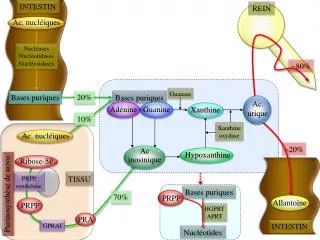
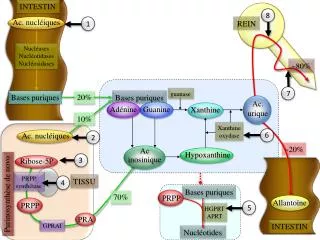
This article explores the metabolic pathways of purines, focusing on the synthesis and degradation of nucleotides in the intestine. Key enzymes involved, such as PRPP synthase, guanase, and xanthine oxidase, play crucial roles in purine metabolism. The interconversion of adenine, guanine, and hypoxanthine is highlighted, with an emphasis on the de novo synthesis pathway contributing to 70% of purine production. The significance of allantoine and its relation to nucleic acids is also discussed, alongside the relevance of various nucleases, nucleotidases, and nucleosidases.

Purine Metabolism and Nucleotide Synthesis in the Intestine: Key Enzymes and Pathways
E N D
Presentation Transcript
INTESTIN Ac. nucléiques Ac. urique Ribose-5P PRPP PRPP PRA Allantoïne 8 REIN 1 Nucléases Nucléotidases Nucléosidases ~80% 7 guanase 20% Bases puriques Bases puriques Adénine Guanine Xanthine 10% Xanthine oxydase 6 Ac. nucléiques 2 ~20% Ac inosinique Hypoxanthine 3 PRPP synthétase TISSU 4 Bases puriques Purinosynthèse de novo 70% 5 HGPRT APRT INTESTIN GPRAT Nucléotides