Download
1 / 1
10 likes | 109 Vues
This research study explores the impact of Problem-Based Instruction in STEM education for elementary students, focusing on enhancing problem-solving skills and scientific understanding through real-life applications. By integrating engineering and technology solutions into the curriculum, students work in cooperative groups to tackle challenges, increasing their participation and developing respectful relationships. The study emphasizes the importance of taking risks in learning and motivating students to take ownership of their education. The results show improved abilities in problem-solving and a positive learning atmosphere. The research recommends using Problem-Based Instruction to prepare students with problem-solving skills and review scientific steps in implementing solutions in science.

E N D
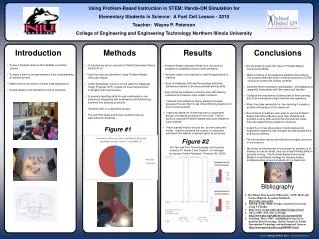
Using Problem-Based Instruction in STEM: Hands-ON Simulation for Elementary Students in Science: A Fuel Cell Lesson - 2010 Teacher: Wayne P. Peterson College of Engineering and Engineering Technology Northern Illinois University Introduction Methods Conclusions Results • To see if students improve their abilities a problem- • solvers • To study if there is an improvement in the understanding • of science content • Make science connection in world-wide applications • Create designs and implement science scenarios • Conducted my action research at Smith Elementary School, • District #129 • Used the resource lab where I used Problem-Based • Instruction Model • Smith Elementary school is on the watch for Adequate • Yearly Progress (AYP) it does not meet requirements • in English, math and science • To promote teaching skills through mathematics, and • science by integrating with engineering and technology • solutions into existing curriculum • Students work in cooperative groups • Pre and Post Tests and Survey Questionnaire for • data collection methods • Problem-Based Instruction Model is a tool used for • students to understand how to solve problems • Students need to be exposed to real-life applications in • learning • Used to challenge and help the average and lower • achieving students to develop problem-solving skills • High achieving students in science and math making • connections to explore other subject contents • I learned to be patient by letting students struggle, • because it forces them to ask critical thinking questions in • how to solve problem • I saw both spectrum of learning from a cooperative • groups of students confused in their roles. I like to • continue using the Problem-Based Instruction Model for • future classes • I have learned what to do and not do from using this • model. I believe students are curious in trying new • activities if the teacher is excited about its outcomes • Not all students prefer this type of Problem-Based • Instructional Model • Make solutions to the situations students were able to • link science and math skills in finding solutions in STEM • curriculum across the subject contents • Students effort increased in participation and displayed a • respectful relationship with their peers and teacher • Stresses the importance of taking risks in their learning • and to be motivated by their interests and questions • When they take ownership for their learning it creates a • positive atmosphere in the classroom • Recommend to teachers who want to use the Problem- • Based Instruction Model to prep their students with • problem-solving skills and review the scientific steps • they use implementing solutions in science • A rapid flux of new discoveries in technologies and • engineering materials has changed the way people think • and solve problems • The environment issues and alterative energies are more • in the forefront • My sense of achievement and success for students is to • develop an eye for detail, and use critical thinking skills in • problem-solving. The Problem-Based Instructional • Model is a worthwhile strategy for meeting today’s • multiple learning styles in students in my classroom Figure #1 Figure #2 Pre Test and Post Tests Averages and incorrect answers for Grade 3 and Grade 4, for hydrogen fuel project. Action Research, Peterson W. (2009). Bibliography • The Illinois State board of Education. (2010) Math and • Science Rigorous Learning Standards. • http://isbe.state.us/ils1 • Ullirich, Kathy (2004). Design Constructivist Lesson Using 5 E Model. • http://www.cte.jhu.edu/technology/webquest.html • 4. Nova (2009). Fuel cell Car Design. • http://www.pbs.org/wgbh/nova/sciencenow/html • Greening, Tony (1998). Scaffolding for Success in problem-Based Learning. Ballart Journal of School • Information Technology and mathematical Sciences • http://www.med-ed-online.org/f0000012.html