Analyzing Environmental and Social Factors in the Anasazi Civilization's Decline
70 likes | 179 Vues
This analysis explores Jared Diamond's five factors contributing to societal collapse, specifically focusing on the Anasazi civilization. It examines human environmental impacts like deforestation and drought, the effects of climate change, the dynamics of trading zones, and internal conflicts among trade partners. Furthermore, it considers how society's responses, influenced by religious and political factors, shaped their fate. The discussion delves into the Anasazi's legacy, modern Puebloan views, and the resilience of Puebloan culture over 1,500 years.


Analyzing Environmental and Social Factors in the Anasazi Civilization's Decline
E N D
Presentation Transcript
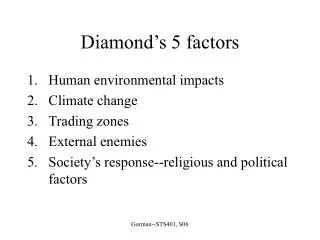
Diamond’s 5 factors • Human environmental impacts • Climate change • Trading zones • External enemies • Society’s response--religious and political factors Gorman--STS401, S06
Four Corners Map Gorman--STS401, S06
Diamond’s 5 & the Anasazi • Deforestation and arroyo cutting • Lengthy drought at the time Chaco and other sites were abandoned • Drought affected trade partners? • No evidence of external enemies, but trade partners may have turned on each other. • Response was moving closer to rivers Gorman--STS401, S06
Montezuma’s (Sinagua) castle (ca 1400) Gorman--STS401, S06
Is Diamond right? • Anasazi literally means “enemies of our ancestors,” in Dine (Navajo) • Modern Puebloan view: their ancestors left Chaco because whatever it was they set out to accomplish was done. Prophecy? • How to explain the violence at some sites? Later Puebloans abandoned sites during Spanish period Gorman--STS401, S06
Puebloan civilization as model for success? • Has lasted for about 1500 years, and still thrives in the Southwest • Includes several distinct nations and linguistic groups • Retains a private cultural heritage • Only New World civilization to drive the Spanish out (1680-92), despite guns, germs & steel… Gorman--STS401, S06
Taos pueblo Gorman--STS401, S06