L15 LP Problems
This guide discusses the essential concepts of Linear Programming (LP) and Curve Fitting methods, emphasizing their applications, history, and problem-solving techniques. It explores the significance of LP in various industries, providing insight into real-world scenarios like transportation and petroleum refining. The document details the transformation of LP problems into standard forms, discusses elimination methods for solving systems of equations, and introduces the Simplex method for finding optimal solutions. Key terminologies and methods, including Goodness of Fit and coefficient of determination (R²), are also introduced.

L15 LP Problems
E N D
Presentation Transcript
L15 LP Problems • Homework • Review • Why bother studying LP methods • History • N design variables, m equations • Summary
Curve Fitting Need to find the parameters ai Another way? Especially for non-linear curve fits?
Goodness of fit? • R2 = coefficient of determination 0≤R2≤1. • R = correlation coefficien
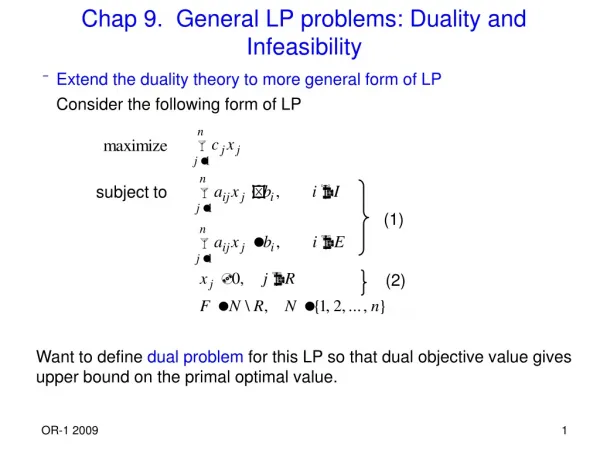
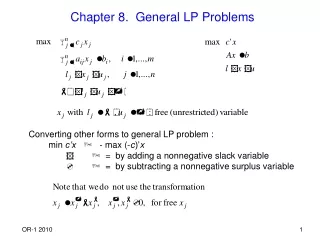
Linear Programming Prob.s Linear
Why study LP methods • LP problems are “convex” If there is a solution…it’s global optimum • Many real problems are LP Transportation, petroleum refining, stock portfolio, airline crew scheduling, communication networks • Some NL problems can be transformed into LP • Most widely used method in industry
Std Form LP Problem Matrix form All “=“ All “≥0” i.e. non-neg. How do we transform an given LP problem into a Standard LP Prob.?
Recall LaGrange/KKT method Add slack variable Subtract surplus variable
Handling negative xi When x is unrestricted in sign:
Solving systems of linear equations n equations in n unknowns Produces a unique solution, for example
Elimination methods Gaussian Elimination
Elimination methods cont’d Gauss-Jordan Elimination
Can we find unique solutions forn unknowns with m equations? 5 unknowns and 2 equations! What’s the best you can do? MUST set 3 xi to zero! Solve for remaining 2. Just like us=0 in LaGrange Method!
m equations= m unknowns Most we can do is to solve for m unknowns, e.g. we can “solve” for 2 xi but which 2?
Combinations? m=2, n=5
Combinations from m=2, n=2 m=2, n=4
Example 8.2 Figure 8.1 Solution to the profit maximization problem. Optimum point = (4, 12). Optimum cost = -8800. 5 unknowns, n=5 3 equations, m=3 10 combinations
Example 8.2 cont’d Solutions are vertexes (i.e. extreme points, corners) of polyhedron formed by the constraints
Example 8.2 cont’d • Ten solutions created by setting (n-m) variables to zero, they are called basic solutions • Some of them were basic feasible solutions • Any solution in polygon is a feasible solution • Variables not set to zero are basic variables • Variables set to zero = non-basic variables
Ex 8.4 cont’d Pivot row Pivot column
Method? • Set up LP prob in “tableau” • Select variable to leave basis • Select variable to enter basis (replace the one that is leaving) • Use Gauss-Jordan elimination to form identity sub-matrix, (i.e. new basis, identity columns) • Repeat steps 2-4 until opt sol’n is found!
Can we be efficient? • Do we need to calculate all the combinations? • Is there a more efficient way to move from one vertex to another? • How do we know if we have found the opt solution, or need to calculate another tableau? SIMPLEX METHOD! (Next class)
Summary • Curve fit = min Sum Squared Errors Min SSE, check R • Many important LP problems • LP probs are “convex progprobs” • Need to transform into Std LP format slack, surplus variables, non-negative b and x • Polygon surrounds infinite # of sol’ns • Opt solution is on a vertex • Must find combinations of basic variables