Between the Wars
In the aftermath of World War I, the 1920s marked a period of significant change in the United States, characterized by a booming economy, vibrant social shifts, and cultural milestones. The economic prosperity gave rise to new technologies, a flourishing arts scene exemplified by the Harlem Renaissance, and the emergence of the flapper culture, signifying women's evolving roles. Meanwhile, European nations faced challenges in rebuilding and stabilizing after the war, leading to economic struggles and a rise in unemployment. The era's optimism faded as the Great Depression began with the 1929 stock market crash.

Between the Wars
E N D
Presentation Transcript
Between the Wars 1918-1939
In the 1920s… America Swings
America Swings? • U.S. economy BOOMING • Made $$$ after WWI • Dominated Trade • Increase in American business
Glamour The Charleston
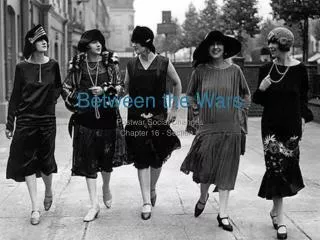
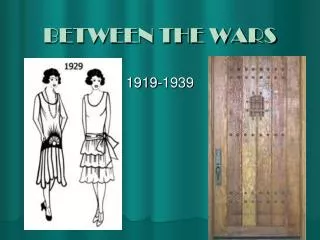
New Role of Women • Had worked outside of the home during WWI • New equality (i.e. voting rights!) • The Flapper – boy haircuts, pants, etc.
Harlem Renaissance • Explosion of art, music, & literature in African American communities • 1920’s – Golden Age of Jazz
Prohibition • Organized crime, speakeasies & prohibition
New Technology • Several changes made the use of electrical household appliances more widespread
New Technology • By 1930, 70% of homes had electricity • Merchants offered installment plans • Use of advertising grew
New Communication • 1920, world’s 1st commercial radio station began broadcasting • Stories, News, Sports, Drama, Comedy & advertising • Worldwide events seen and heard…
New Communication • Motion pictures became a major industry in 1920’s • 90% of movies made in Hollywood • Silent at first, but 1927 first “talkie”
1) Death • Russia & France lost the most lives during World War I • After World War I both countries were motivated by their desire to avoid another war
2) Destruction • Western Europe (especially France) was largely destroyed by German advances during World War I • Needed to REBUILD!
3) Unemployment • Due to poor economic conditions after World War I, Europe experienced high rates of unemployment • Soldiers returned home to NO JOB!!
5) Disease • 1918 influenza pandemic more people died than in all of World War I • (and more than 4 years of the Black Death!)
Weimar Republic (1919-1933) – Germany attempted to establish a liberal republic But BIG problems! Germany & the Weimar Republic
Inflation: German money so worthless they burn it to keep warm!
Dawes Plan (1924): provided for a $200 million loan from American banks to stabilize German economy Also set a more realistic schedule for Germany’s reparation payments Germany & the Weimar Republic
Lasting Peace? • Locarno Treaty (1925): • France & Germany would not go to war against each other again • After signing treaty, Germany was admitted to League of Nations
Lasting Peace? • Kellogg-Briand Pact (1928): • Almost every country agreed to “renounce war as an instrument of national policy”
Lasting Peace? • BUT…League of Nations had: • No armed forces • No way to enforce agreements
THEN…In 1929 the American Stock Market Crashes leading to a WORLDWIDE economic depression
Worldwide Depression • People started to turn towards government to deal with economic crisis • Governments step in to direct economies & recovery effort (socialism!)
Worldwide Depression • Franklin D. Roosevelt (FDR) deals with the Depression in the United States • New Deal – program of government reform
Worldwide Depression • Nations like G.B., France, & U.S. are able to remain democratic, BUT… • Depression causes people to lose faith in democracy • Opens the door for the rise of Totalitarian Regimes…