

SlideServe
Menu
Préférences
© SlideServe · v2026

Between the Wars

lyle avatar
9 diapositives · 305 Views · Jul 22, 2014

Between the Wars. Postwar Social Changes Chapter 16 - Section 1. Do Now: Monday 4/1/13. What is the message of this political cartoon? Look closely at the ENTIRE picture. Changes in Society. Young people rejected their parents values
Between the Wars - slide 1
01 / 9Between the Wars
1 / 17

Télécharger la présentation

Between the Wars
Une image / un lien ci-dessous est fourni (tel quel) pour télécharger la présentation

Politique de téléchargement : le contenu du site vous est fourni TEL QUEL pour votre information et votre usage personnel ; il ne peut être vendu, concédé sous licence ni partagé sur d’autres sites sans l’accord de son auteur.Le contenu vous est fourni TEL QUEL, pour votre information et votre usage personnel uniquement. Téléchargez la présentation en cliquant sur ce lien. Lors du téléchargement, si vous ne parvenez pas à télécharger une présentation, l’éditeur a peut-être supprimé le fichier de son serveur.Pendant le téléchargement, si vous ne parvenez pas à obtenir une présentation, le fichier a peut-être été supprimé par l’éditeur.

F I N

Plus de contenu associé

Transcription de la présentation
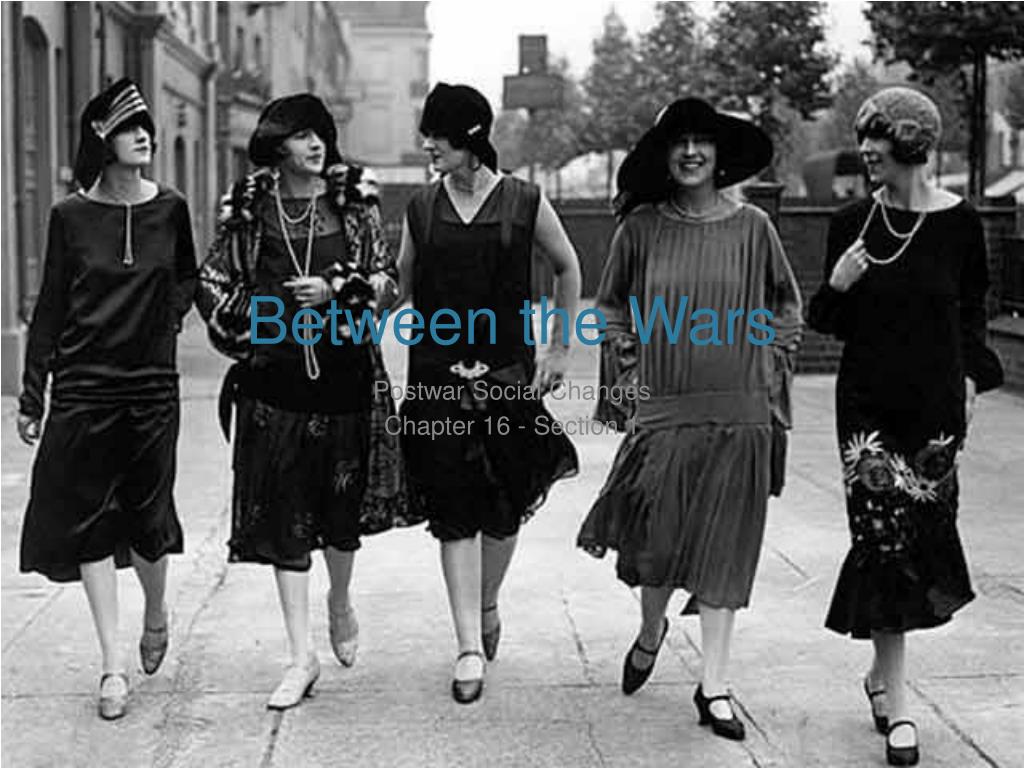
  1. Between the Wars Postwar Social Changes Chapter 16 - Section 1

  2. Do Now: Monday 4/1/13 What is the message of this political cartoon? Look closely at the ENTIRE picture.

  3. Changes in Society • Young people rejected their parents values • WWI shattered the idea of optimism brought on by the Enlightenment • Reaction  society & culture changed rapidly in Europe & U.S.

  4. The Roaring Twenties • New technologies = new culture • Affordable cars, • improved telephone communication, • media motion pictures & radio • JAZZ African American musicians combined Western harmonies with African rhythms. • Louis Armstrong Hot Five • Duke Ellington Cotton Club • The 1920s became known as the Jazz Age

  5. Europe Recovers • U.S. experienced a “boom” after WWI • Europe embraced American culture • Nightclubs and jazz were symbols of freedom • Young people rejected moral values and rules of the Victorian Age • Flapper  symbol of rebellious Jazz Age • First were American • European’s soon adopted the fashion • flapper, Coco Chanel

  6. U.S. Reacts to Jazz Age • Prohibition  1919-1933 • 18thAmendment • Keep people from the “negative effects of drinking” • Speakeasies and organized crime exploded • 1925  Scopes Trial in Tennessee • John T. Scopes taught evolution in his class

  7. New Scientific Discoveries • Atomic bomb  Italian Enrico Fermi, American physicists J. Robert Oppenheimer, and Edward Teller • 1939 proposed to US government by Einstein • Government reacted slowly to atomic bomb • 1944  Manhattan Project in New Mexico • Split nuclei of atoms in two produces huge burst of energy • Penicillin  Scottish scientist Alexander Fleming • Freud  Psychoanalysis

  8. Exit Ticket Explain THREE ways society changed after WWI.