Advanced Solar Monitoring: GOES Space Weather Instruments and Their Applications
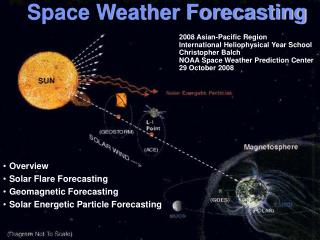
The GOES (Geostationary Operational Environmental Satellites) suite utilizes a range of instruments like the Solar Imaging Suite (SIS) and Space Environment In-Situ Suite (SEISS) to monitor solar activity and its impact on space weather. Key functions include detecting solar X-ray flares, measuring solar radiation variability, analyzing coronal mass ejections (CMEs), and monitoring charged particle fluxes in geosynchronous orbit. This comprehensive data aids in geomagnetic storm forecasts and understanding solar energetic particle events, crucial for space weather predictions and protecting satellite operations.

Advanced Solar Monitoring: GOES Space Weather Instruments and Their Applications
E N D
Presentation Transcript
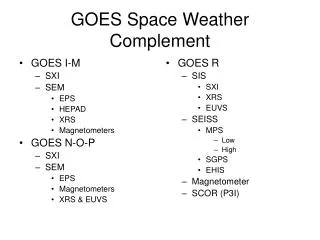
GOES I-M SXI SEM EPS HEPAD XRS Magnetometers GOES N-O-P SXI SEM EPS Magnetometers XRS & EUVS GOES R SIS SXI XRS EUVS SEISS MPS Low High SGPS EHIS Magnetometer SCOR (P3I) GOES Space Weather Complement
Solar Imaging Suite (SIS) - 1 • Sun-staring instruments. • Solar X-Ray Imager • Full solar disk imager in soft x-ray to EUV. • Locate coronal holes for geomagnetic storm forecasts • Detect and locate flares for forecasts of solar energetic particle events related to flares • Monitor changes in the corona that indicate coronal mass ejections (CMEs) • Detect active regions beyond east limb for F10.7 forecasts • Analyze active region complexity for flare forecasts.
Solar Imaging Suite (SIS) - 2 • X-Ray Sensor (XRS) • Measures solar X-ray output. • Primary measure of and standard for solar flare magnitude. • Detects the beginning, duration, and magnitude of solar X-ray flares. • Input for the empirical model of Solar Energetic Proton events.
Solar Imaging Suite (SIS) - 3 • Extreme Ultra-Violet Sensor (EUVS) • Measures solar variability in EUV radiation. • Primary driver in ionospheric/thermospheric variability.
Space Environment In-Situ Suite (SEISS) - 1 • Monitor the proton, electron, and heavy ion fluxes at geosynchronous orbit. • Geomagnetically trapped and highly variable population of electrons and protons • Sporadic fluxes of electrons, protons, and heavy ions of direct solar origin (e.g. from flares) • Background of galactic cosmic rays ranging from several MeV to highly relativistic energies.