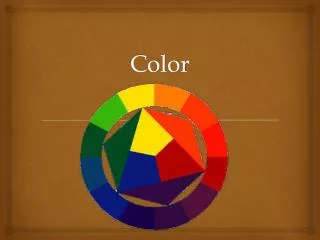
Color
Color. Kyongil Yoon. Color. Chapter 6, “Computer Vision: A Modern Approach” The experience of colour Caused by the vision system responding differently to different wavelengths of light. Radiometric vocabulary to describe energy arriving in different quantities at different wavelengths

Color
E N D
Presentation Transcript
Color Kyongil Yoon
Color • Chapter 6, “Computer Vision: A Modern Approach” • The experience of colour • Caused by the vision system responding differently to different wavelengths of light. • Radiometric vocabulary to describe energy arriving in different quantities at different wavelengths • Human color perception • Different ways of describing colors VISA
The Physics of Color • Per unit wavelength to yield spectral units • BRDF or albedo with wavelength • Spectral radiance • The color of source • Black body radiators • Spectral power distribution depends only on the temperature of the body • Color temperature of a light source • The sun and the sky • The sun: a point light source, daylight, yellow • The sky: a source consisting of a hemisphere with constant existence, skylight (airlight), blue • Artificial Illumination • Incandescent light: roughly black-body model • Fluorescent light: bluish tinge, mimic natural daylight • Others VISA
The Physics of Color • The color of surfaces • Result of various mechanisms: different absorbtion at different wavelengths, refraction, diffraction, bulk scattering • (Spectral) reflectance + (spectral) albedo • Specular reflection VISA
Human Color Perception • Color matching • Let people match a given color using a certain number of primaries • Subtractive matching • Trichromacy • Three primaries are required • Subtractive matching, Independent • Implies three distinct types of color transducer in the eye • Grassman’s law • If we mix two test lights, then mixing the matches will match the resultif Ta = wa1P1+wa2P2+wa3P3 and Tb = wb1P1+wb2P2+wb3P3then (Ta + Tb) = (wa1+wb1)P1+(wa2+wb2)P2+(wa3+wb3)P3 • If two test lights can be matched with the same set of weights, then they will match each otherif Ta = wa1P1+wa2P2+wa3P3 and Tb = wb1P1+wb2P2+wb3P3then Ta = Tb • Matching is linearif Ta = wa1P1+wa2P2+wa3P3 then kTa = (kwa1)P1+(kwa2)P2+(kwa3)P3 • Some exceptions VISA
Human Color Perception • Color receptors • We can assume that there are three distinct types of receptor in the eye that mediate color perception • Turns incident light into neural signals • The principle of univariance • The activity of receptors is of one kind • Rods and Cones • Cones dominate color vision • Three type of cones differentiated by their sensitivity • S, M, and L cones (not necessarily blue, green, and red) VISA
Representing Color (Linear Color Spaces) • Linear color space • Agree on a standard set of primaries • Describe any color light by the three weights • Easy to use • Color matching functions • Unit radiance source • Spectral radiance source • How to deal with subtractive matching • Negative weight value • Standardization by CIE • Commission international d’eclairage VISA
Linear Color SpacesCIE XYZ • Popular standard • Color matching functions were chosen to be everywhere positive • Impossible to get primaries VISA
CIE xy • The horseshoe line (spectral locus) is the spectral locus. • Hue changes one moves around the spectral locus • Out-of-date? VISA
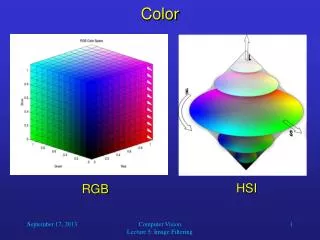
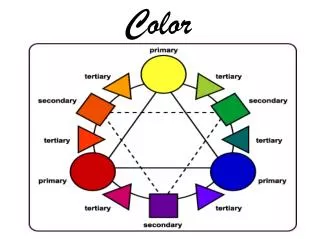
Linear Color Spaces • RGB • Uses single wavelength primaries(645.16nm for R, 526.32nm for G, 444.44nm for B) • CMY and black • Red, yellow, blue: primary colors in subtractive mixture • Simplest color space for subtractive matching • Cyan (W-R), Magenta (W-G), Yellow (W-B) • C+M = (W-R) + (W-G) = R+G+B-R-G = B • Practical printer uses an additional black • Quality • Cost VISA
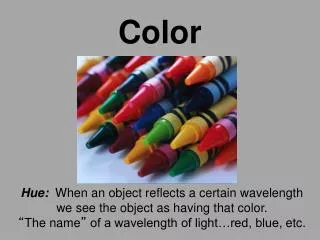
Representing Color (Non-Linear Color Space) • Disadvantage of linear space • Does not encode common properties such hue, saturation • Not intuitive • Hue, saturation, and value • Hue: the property that varies in passing from red to green • Saturation: the property that varies in passing from red to pink • Value: brightness (lightness) VISA
Non-Linear Color SpaceUniform Color Space • Uniform color space • The distance in coordinate space is a fair guide to the significance of the difference • Just noticeable differences • CIE u’v’ space • CIE LAB • Most popular • Good guide to understand howdifferent two colors will look to a human observer VISA
Spatial and Temporal Effects • Chromatic adaptation • Assimilation • Contrast VISA
Statistical Modeling of Colour Data • Daniel C. Alexander, Bernard Buxton • Become standard to model • Single mode distribution of color data by ignoring the intensity component and constructing a Gaussian model of the chromaticity VISA