Inferential Statistics in Research
Learn about sampling distributions, estimation methods, hypothesis testing, and common errors in inferential statistics. Explore practical applications of hypothesis testing in various research designs using statistical techniques.


Inferential Statistics in Research
E N D
Presentation Transcript
15 Inferential Statistics
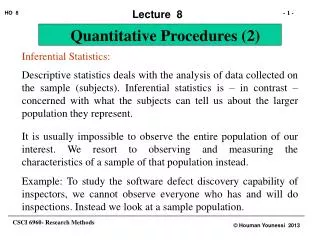
Inferential Statistics • Inferential statistics involve using sample data to make inferences about populations • a statistic is a numerical index based on sample data • a parameter is a numerical characteristic of a population
Sampling distributions • A sampling distribution is a theoretical distribution of values of a statistic consisting of every possible sample of a given size from a population • standard error – the standard deviation of a sampling distribution • test statistic – statistic that follows a known sampling distribution and is used in significance testing
Estimation • A branch of inferential statistics involved in estimating population parameters • point estimation – use value of sample statistic as estimate of the value of population parameter (e.g., sample mean to estimate population mean)
Estimation (cont'd) • A branch of inferential statistics involved in estimating population parameters • interval estimation • confidence interval – includes a range of numbers that will contain the population parameter with a certain degree of certainty. e.g., 95% confidence intervals include a range of values that will contain the population parameter 95% of the time
Hypothesis Testing • Branch of inferential statistics used when testing the predicted relationship between variables • null hypothesis - a statement regarding the population parameter – typically that no relationship exists between the independent and dependent variables
Hypothesis Testing (cont'd) • Branch of inferential statistics used when testing the predicted relationship between variables • alternative hypothesis – states that there is a relationship between independent and dependent variables
Hypothesis Testing (cont'd) • Steps of hypothesis testing • state the null and alternative hypotheses • begin by assuming that the null hypothesis is true (that the independent variable has no effect) • determine the standard for rejecting the null hypothesis (i.e., identify the level of significance)
Hypothesis Testing (cont'd) • Steps of hypothesis testing • calculate the test statistic (e.g., t-test) • make a decision – if result of test statistic is unlikely to occur by chance (that is, if the p value is less than the alpha level), reject the null hypothesis • calculate effect size indicators to determine practical significance
Hypothesis Testing (cont'd) • Directional alternative hypotheses • predicts the direction of an effect • increases statistical power • cannot reject null if effect is opposite of prediction
Hypothesis Testing (cont'd) • Hypothesis testing errors • Type I error occurs when the researcher incorrectly rejects the null hypothesis • Type II error occurs when the researcher fails to reject a false null hypothesis
Hypothesis Testing (cont'd) • Hypothesis testing errors • reducing the alpha level reduces the risk of a Type I error but increases the risk of a Type II error • researchers are usually more concerned about Type I errors
Hypothesis Testing in Practice • The basic steps of hypothesis testing are used with a number of different research designs and statistical techniques • The t Test for Correlation Coefficients • used to determine whether an observed correlation coefficient is statistically significant • null hypothesis assumes that correlation = 0
Hypothesis Testing in Practice (cont'd) • One-way Analysis of Variance (ANOVA) • compares two or more group means • null assumes that all population means are equal; alternative is that at least two are different
Hypothesis Testing in Practice (cont'd) • One-way Analysis of Variance (ANOVA) • if null is rejected, post-hoc tests needed to determine which groups are different (if more than two groups are compared) • post-hoc tests allow multiple comparisons without inflating risk of a Type I error • common post-hoc tests include Tukey’s HSD, Neuman-Keuls, and Bonferroni
Hypothesis Testing in Practice (cont'd) • Analysis of Covariance (ANCOVA) • extension of ANOVA • includes a quantitative independent variable as a “covariate” • increased power over ANOVA
Hypothesis Testing in Practice (cont'd) • Two-way ANOVA • includes two categorical independent variables • tests three null hypotheses • main effects for each independent variable • interaction • a significant interaction generally takes precedence over main effects
Hypothesis Testing in Practice (cont'd) • One-Way Repeated Measures ANOVA • similar to one-way ANOVA but independent variable is within participants • The t test for Regression Coefficients • tests the significance of regression coefficients obtained in regression analysis • semi-partial correlation squared (sr2) – amount of variance in the dependent variable explained by a single independent variable
Hypothesis Testing in Practice (cont'd) • Chi-Square Test for Contingency Tables • tests the relationship observed in a contingency table • two categorical variables • null hypothesis states that there is no relationship between the two variables
Hypothesis Testing and Research Design • The following tables list the appropriate statistical analyses to be used with research designs discussed in the text