Download
1 / 3
40 likes | 187 Vues
This article explores the historical development of atomic theory, beginning with Democritus in 450 B.C., who proposed the concept of the atom as indivisible matter, despite being overshadowed by the ideas of Plato and Aristotle. It highlights key figures such as Pierre Gassendi, who revived atomic theory in the 1600s, and John Dalton, who formulated significant chemical laws in the 18th century. The article also covers Robert Brown's discovery of Brownian motion and Dmitri Mendeleev's creation of the periodic table, which organized elements based on their properties.

E N D
Atoms, Molecules, and Matter Democritus ~ 450 B.C. – argued that by cutting up a piece of matter with sharpest knife imaginable, would eventually come to a piece that would not be cut any further: Atom = (Greek word – indivisible) Idea rejected by Plato and Aristotle – matter is continuous. Due to their influence, Democritus Theory was left dormant for 20 centuries.
Pierre Gassendi (1592-1655) Italian supported by Newton 1600’s: suggests the existence of atoms John Dalton (1776-1844) English chemist and school teacher Developed several laws of chemistry using atomic theory Atoms join to form molecules
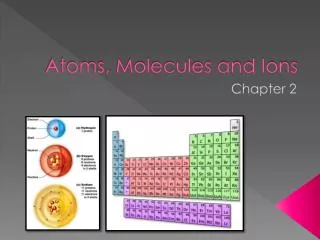
Robert Brown (1773-1858) Scottish botanist 1827: looked at pollen grains (suspended in water) under microscope – Browian Motion Explained by Einstein (collision and momentum problem) Dmitri Mendeleev (1834-1907) Period table (only 63 elements) Period = rows Groups = columns (elements that had similar properties = families)