Atoms, Molecules and Matter
200 likes | 227 Vues
Discover the building blocks of the universe with this in-depth exploration of atoms, compounds, and matter. Learn about the properties of molecules, compounds, diatomic molecules, mixtures, and states of matter. Unveil the secrets hidden within the smallest particles.


Atoms, Molecules and Matter
E N D
Presentation Transcript
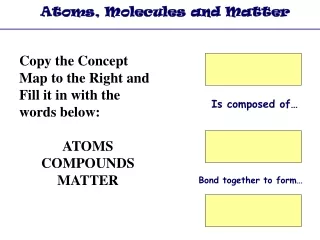
Atoms, Molecules and Matter Copy the Concept Map to the Right and Fill it in with the words below: ATOMS COMPOUNDS MATTER Is composed of… Bond together to form…
Atoms, Molecules and Matter Matter Is composed of… Atoms Bond together to form… Compounds
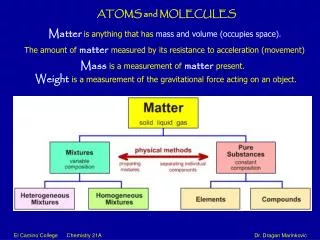
Matter • Matter is the “stuff” of which the universe is composed. • Two characteristics: has mass and occupies space.
Atoms • Can we see atoms? • Scanning Tunneling Microscope • Matter is composed of tiny particles called atoms. A scanning tunneling microscope image of 5 nm gold nanoparticles www.chem.utoronto.ca/ staff/DHIRANI/
Compound vs Molecules • A molecule is formed when two or more atoms join together chemically. • A compound is a molecule that contains at least two different elements. • All compounds are molecules but not all molecules are compounds.
Molecules • Molecular hydrogen (H2), and molecular oxygen (O2) are molecules because each is composed of a single element. • Water (H2O), carbon dioxide (CO2) and methane (CH4) are compounds because • each is made from more than one element. • The smallest bit of each of these substances would be referred to as a molecule.
Compounds • Atoms of different elements can join together by chemical bonds to form a compound • A compound has totally different properties from its elements
Sodium Chloride • Sodium: Silvery White Metal Chlorine: Pale Green Gas http://en.wikipedia.org/wiki/Sodium http://en.wikipedia.org/wiki/Chlorine
Diatomic Molecules NOFClBrI [H] Nitrogen Bromine Oxygen Iodine Fluorine Hydrogen Chlorine
Diatomic Molecules BrINClHOF Bromine Iodine Nitrogen Chlorine Hydrogen Oxygen Fluorine
States of Matter Solid Liquid Gas Model
Mixtures • A mixture is a substance made by combining two or more different materials in such a way that no chemical reaction occurs. • A mixture can usually be separated back into its original components. What are examples of mixtures?
Prefixes • Homo: • Greek = Same • Latin = Human • Hetero: • Greek = Mixed What words using these prefixes come to mind?
Mixtures • Homogenous Mixture: the particles are mixed so well that the separate parts cannot be seen (Salt Water) • Heterogenous Mixture: the different parts can be easily seen (Salt and Pepper)
Sand close up collections.ic.gc.ca/.../ magnified-sand_sa.htm
Homogeneous Heterogeneous Homogeneous Heterogeneous
Element Diamond Bucky Ball
Atom Carbon Bohr Model