Nomads Crossing the Global Divide
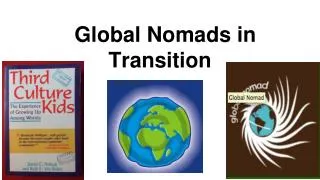
Explore the identities and challenges of Global Nomads and Third Culture Kids through panel discussions, activities, and resources. Learn how to support this unique student population in college environments.

Nomads Crossing the Global Divide
E N D
Presentation Transcript
Nomads Crossing the Global Divide Presented by: Allison Atsuko Fitzgerald Jenn Christ Daniela Cigularova Maka Hutson Region II Highlight NAFSA Annual Conference May 24, 2006
Introductions Allison Atsuko Fitzgerald, afitzge2@du.edu International Student Advising, University of Denver Jenn Christ, jlchrist@lamar.colostate.edu Apartment Life, Colorado State University Daniela Cigularova, dcigu@lamar.colostate.edu Apartment Life, Colorado State University Maka Hutson, maka@austin.utexas.edu Immigration Advisor, University of Texas at Austin
Overview • Definitions • Global Nomad/Third Culture Kid Panel • Small Group Activity: Suggestions for Implementation • Examples Drawn from Various Campuses • Resources for More Information
Definitions Global Nomad: People who have spent their pre-adult years outside their country of passport because of their parents’ occupation. Third Culture Kid: People who have spent their pre-adult years in a dominant culture different than the native culture of their parents. A more inclusive term. Both are also referred to as “hidden immigrants.”
Global Nomad/Third Culture KidPanel Discussion • Please share with us some of your demographic characteristics and what do you consider home. • Please describe your experience in college. • What have been some of the challenges you have faced? • What piece of advice would you give to a GN/TCK entering college? • What should student affairs professionals know about GN/TCK?
Small Group Activity: Suggestions for Implementation • Separate into small groups based on area of focus - education abroad, international student and scholar services, recruitment, admission, preparation • 2. Brainstorm suggestions for colleges to implement, keeping in mind the statistics, benefits, challenges identified in handout. • 3. Questions to discuss: • How do you currently accommodate GN/TCKs in your area? • What else would you like to do to accommodate this population? • How can you connect GN/TCKs with other students? • 4. Come together as larger group and share ideas.
Suggestions from the Presenters • Let staff know GN/TCKs exist through workshops/meetings • Identify GN/TCKs correctly through admission/orientation • Inform GN/TCKs about the profile, if they don’t know already • Provide orientation session that addresses GN/TCK issues • Be flexible in allowing them to select services appropriate to their needs • Encourage GN/TCKs on opportunities to study abroad • Create a support group or mentor program of GN/TCKs • Connect them with international students, study abroad students, return Peace Corps volunteers • Involve GN/TCKs in re-entry/cultural adjustment sessions
Examples Drawn fromVarious Campuses http://www.admissions.colostate.edu/admissions/dsp_intl.cfm?navarea=nomads http://www.pacific.edu/sis/nomads/curriculum.htm http://www.lclark.edu/dept/iso/tck.html http://www.du.edu/~ykawabe/index.html http://www.cafepress.com/tck
Resources forMore Information -References at the end of handout -Global Nomads Special Interest Group listserv: gnsig-l@listserv.utk.edu -Alice Wu's video "Global Nomads: Cultural Bridges for the New Millenium" (40 minutes): aw17@cornell.edu -Contact the presenters!