Download
1 / 33
330 likes | 429 Vues
This paper presents an innovative approach to navigating large landscape images using saliency detection to enhance visual knowledge discovery. By analyzing multi-gigapixel images made possible through techniques such as gigapan imaging and advanced stitching methods, we focus on identifying small yet informative regions that retain significant information. Our algorithm employs multi-scale saliency maps and interactive exploration to reveal anomalous regions and improve the efficiency of exploring vast datasets. This research addresses challenges of visual and data scalability while leveraging multicore processing for real-time analysis.

E N D
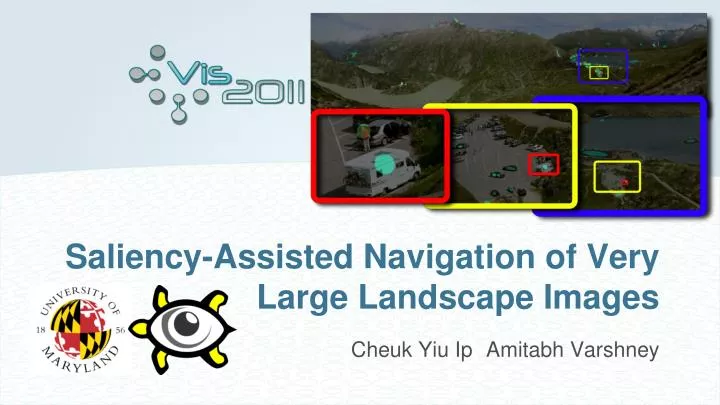
Saliency-Assisted Navigation of Very Large Landscape Images Cheuk Yiu Ip AmitabhVarshney
Very Large Landscape Images • Image Acquisition: • Gigapan • MS HDViewToG 2007 • Image Stitching: • Kazhdan et al ToG 2008, 2010 • Summa et al ToG 2010 • Stitch images to create multi-gigapixel very large images • But WHERE should we start looking?
Visual Knowledge Discovery • Visual knowledge discovery • Identify what is interesting • Visualize them
Information Scalability • Design effective algorithms to process large images • The SMALL unique regions in the large images contain the MOST information • Identify informative regions from repetitive scene elements
Data Scalability • Very large images represent a large amount of data 5 Gpix RGBA = 20GB uncompressed • Multicore and manycore parallel processing • Requires efficient algorithms O(n) and out-of-core GPU methods
Overview • Sliding-Window Saliency Map • Detection Anomalous Regions • Interactive Exploration
Traditional Multiscale Image Saliency • Detects “Pop-out” spots from the scene • Inspired by human visual system • Pre-attentive vision • Find multiscale contrasting regions • Intensity, Color Opponencies (I, RG, BY) • Convolve (I, RG, BY) with Difference of Gaussians (DoG) filter (σ is stdev) • Repeat on downsampled images for multiscales • Image Saliency • Itti et al.PAMI,1998 • Bruce et al. IJCV,2009 • Goferman et al. CVPR 2010 • Work on small images, very accurate but slow.
Multiscale Aggregation • Works well on small images • If we have many more scales … • Large regions dominate small regions • Wait… we don’t want to miss the small regions • Traditional multiscale saliency is insufficient
Our Sliding-Window Aggregation • We see different things at different zoom levels • One saliency map per level • Only aggregate up to 4x • Use a sliding-window across scales • Why 4x? • Eye resolution difference ~5x 16σ – 64σ All (σ - 256σ) 4σ – 16σ σ – 4σ
There are still too many regions… • 18,000+ regions in 1.3Gpix (5 hours if a user spends 1s on each) • Regions are enlarged for visibility • There are many contrasting repetitive elements
Information Discovery • Identify the informative regions from the salient regions • Compare regions to find the most different ones • Detect the anomalous regions and outliers • Visual Data Analysis • Mesh and Volume Saliency (Lee et al. ToG 2005, Kim et al. TVCG 2006) • Video Summarization (Daniel et al. Vis 2003) • Flow and Information Theory (Janicke et al. TVCG 2010) • Molecular Dynamics Layout (Patro et al. Biovis 2011)
Represent salient regions by histograms (rotational invariance) Global Colors RGB, HSV, CIELAB: Not discriminative Local Edges: Too discriminative Histograms of colors in 8x8 moving windows work well(MPEG-7 CSD) Compare histograms, p, q, by the Euclidean distance Image Region Descriptors
k-Nearest-Neighbors Anomaly Detection • Uniqueness, U(p), is the average distance of p to its k-Nearest-Neighbors. • Repeating regions have a low U(p) • Distinct regions have a high U(p) • Spatial data structures (kD-trees) accelerate the retrieval
Where are they … ? • Top 3% (500) of the most distinct regions. • Most of the repeating region are eliminated. • Can you see the remaining regions?
Visualizing the Detected Regions • Problem: Small regions of interests are NOT visible • Adaptively enlarge regions • Determine the scale and colors by the region’s rank of uniqueness • Increase when zooming out • Decrease when zooming in • (Formula in paper)
Automatic Exploration • Explore the regions in descending order of their uniqueness • k-NN anomaly detection step provides uniqueness ordering
Interactive Refinement • Locate similar undesired regions • Select a representative • Move the slider to adjust the coverage • Delete the selection The spatial data structure indexes the regions and provides fast retrieval
After User Refinement • The remaining 300 regions after 3 refinement interactions
Data Scalability • GPU Out-of-core saliency computation • Break the image into tiles • Parallel Gaussian filtering on GPU • Filter overlapping boundary tiles to maintain continuity • Saliency map storage • Fit and store ellipses of the salient regions • Do not store an extra image • Tiled Image Viewer • View dependent mipmap image tiles loading and prefetching for smooth pan and zoom
Gigapan Community Tags Grimsel Pass Royal Gorge Bridge
Gigapan Community Tags Cacti Mount Whitney
Limitations • Buffelgrass after fire • The “Original” cactus • Tags with semantic information • Domain knowledge necessary • Why are they tagged ?
Performance • Each GPix takes 2.5 1 hours to preprocess(1 NVIDIA GeForce GTX 285 GPU and 1 CPU) • Each interaction takes 10 ms
Conclusions • First step on visual knowledge discovery on very large landscape images • Visual Scalability: Sliding-Window Saliency • Information Scalability: Anomaly Detection • Data Scalability: Parallel filtering, Saliency Storage • Interactive Navigation
Future work • There are a lot of very large images • Astronomy • Microscopy • Product inspection • Urban Scenes • Domain specific descriptors • Fast discovery of locally distinct regions. • Accurate Identification of globally unique regions.
Acknowledgements • National Science Foundation: CCF 05-41120, CMMI 08-35572, CNS 09-59979 • NVIDIA CUDA Center of Excellence Program • Derek Juba, SujalBista, Rob Patro, Icaroda Cunha, Yang Yang, AdilYalcin, and the reviewers for improving this paper and presentation • The Vis paper award committees Thank you!
Questions ? • Please see our websitesfor the paper and video: • Cheuk Yiu Ip • www.cs.umd.edu/~ipcy/ • GVIL Research Highlights • www.cs.umd.edu/gvil/